

Tomorrow, I will vote in my first election as an Israeli citizen. I will be voting for the next leader of the world’s only Jewish state. According to the latest Freedom House report (2026), Israel is the only free democracy in the Middle East. Tomorrow’s election will be the 26th election since the reestablishment of Israel as a Jewish state.
This alone should make one question the intentions of our enemies and neighbors. I would argue that this election is the most important election since the 1949 election that immediately followed independence in 1948.
Since its establishment, Arab citizens have had the right to vote in every Israeli election, and equal citizenship was written into Israel’s Declaration of Independence. A Muslim Arab can serve on Israel’s Supreme Court, which has the legal right to overturn legislation. In addition, Arabs can serve in the Knesset and theoretically even be elected to the position of president or prime minister.
I provide this history to give readers a clear understanding of the level and sophistication of Israeli democracy.
38 political parties are participating in the election tomorrow and represent 13 different political factions. This makes choosing a candidate all the more difficult. In Israel, you vote for the political party, which receives a certain number of seats in the Knesset (parliament), and then the representatives of parliament vote for the prime minister, who is the head of government.
I believe my political views are well-known. I am a religious Zionist, and I live in Judea and Samaria, in a town called Efrat. I believe in law and order. I completely oppose violence by both Jews and Palestinian civilians toward each other. I also believe in Ahavat Yisrael, loving my fellow Jew.
To further expand on my position, I believe in universal conscription in Israel, and I believe that all of Israeli society should serve in the Israel Defense Forces, including Charedi Jews. I believe this is a matter of life and death, Pikuach Nefesh, saving a life.
I believe in democracy, in the right of people to elect their government, and in the rights of people to have their own beliefs and belief systems. But I also believe in respect, in respecting other people and respecting their belief systems.
Fundamentally, my position as a religious Zionist is extremely difficult in this upcoming election because I want to make sure my vote matters, and I want to make sure it is relevant. I also want to make sure that I am supporting a party whose agenda matches my own personal agenda, and there are a lot of choices.
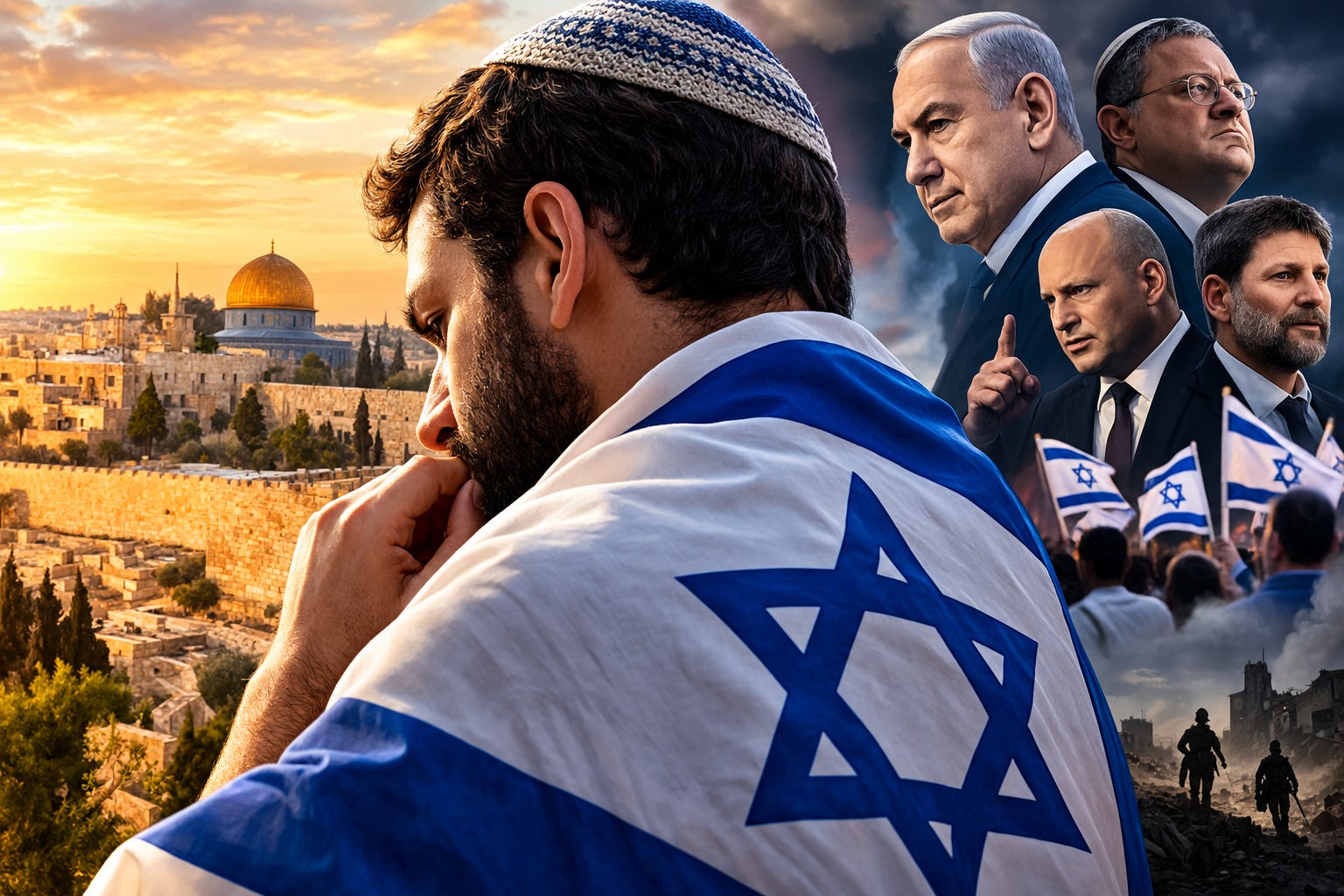
In my opinion, my political and religious positions leave me to choose from these four parties: Religious Zionism–Zehut, led by Bezalel Smotrich; Likud, led by Benjamin Netanyahu; Together (Beyachad), led by Naftali Bennett and Yair Lapid; and Otzma Yehudit (Jewish Power), led by Itamar Ben-Gvir.
I cannot vote for Ben-Gvir, as I believe he is doing a great amount of damage to Israel and the Jewish people.
I view Naftali Bennett’s alliance with Yair Lapid as counterproductive, and it moves their party way too far left of center for me to support.
I am angry with Netanyahu after October 7th and feel that he has not taken responsibility for the attack, has diverted attention away from the issues, and, in order to form a coalition, has aligned himself with Ben-Gvir, whom I believe is a threat to Israel’s national security. Which is weird because he is the national security minister.
I am leaning toward voting for Smotrich and the Religious Zionist Party because, in my opinion, he has done more for the settlement enterprise since the reunification in 1967 than anyone else in Israel’s history.
I support the settlements, believe they are what G-D wants, and believe they are essential to securing Israel with defensible borders.
So there you have it. I will be voting tomorrow, and I will be making my choice.
I am a proud Zionist, a proud Israeli, but most of all, I am a proud Jew who believes in one G-D, the G-D of Israel.