



Yesterday evening, my family and I wandered through Jerusalem’s German Colony, strolling along the old railway line that has been transformed into one of the city’s most enjoyable public spaces. Families pushed strollers. Children raced ahead on bicycles. Friends lingered over coffee. Hebrew, Arabic, English, French, Russian, and Spanish drifted through the warm Jerusalem air. The smell of fresh bread mixed with grilled food from nearby restaurants while the setting sun painted the old stone buildings in shades of gold.
Then, while walking those tracks, a thought stopped me in my tracks.
These railway lines were laid in the 1930s. Around the very same time, another nation was laying railway lines of its own.
One railway would eventually bring families together.
The other would transport families to their deaths.
That contrast is almost impossible to comprehend.
The railway through Jerusalem’s German Colony was part of a transportation network connecting Jerusalem to the rest of the country. It carried passengers, commerce, pilgrims, soldiers, and dreamers. Decades later, after the railway ceased operating, Israel transformed the corridor into something entirely different: a beautiful public promenade where people from every background gather together.
Meanwhile, in Nazi Germany and across occupied Europe, railway infrastructure became one of history’s most efficient instruments of industrialized murder. The Holocaust was not only carried out by guns and gas chambers. It depended on timetables, freight cars, logistics, engineers, bureaucrats, and railway workers who kept the trains moving. Millions of Jews were loaded into cattle cars and transported to extermination camps including Auschwitz-Birkenau, Treblinka, Sobibor, and Belzec.
The same century.
The same technology.
The same steel rails.
One civilization built tracks to connect people.
Another built tracks to annihilate them.
That is the difference.
Many people don’t know the remarkable history of Jerusalem’s German Colony. Founded in 1873 by members of the German Templer movement, the neighborhood was established by German Protestant settlers who believed they could prepare the Holy Land for the Second Coming through hard work and agriculture. They constructed elegant stone homes with distinctive red-tiled roofs, planted tree-lined streets, and created one of Jerusalem’s first carefully planned modern neighborhoods outside the walls of the Old City.
History, however, has a way of refusing to stay simple.
When the Nazis rose to power, a significant number of Templers living in Palestine identified with Germany. Nazi Party activity even appeared within parts of the Templer community. During the Second World War, the British authorities interned or deported many German nationals. After Israel’s independence, the remaining German properties were transferred to the new state, and Jewish families, including Holocaust survivors and immigrants from around the world, gradually filled the neighborhood with new life.
There is extraordinary symbolism in that transformation.
A neighborhood established by Germans now flourishes as a thriving Israeli community.
Not through revenge.
Through life.
Today the German Colony is one of Jerusalem’s most vibrant neighborhoods. Beautiful cafés spill onto shaded sidewalks. Boutique shops sit beside bookstores. Synagogues stand near churches. Locals and tourists fill the streets from morning until late at night. Walk a few minutes and you reach the First Station complex, the old Ottoman-era railway station that has become a lively cultural center. Continue along the old Railway Park and you’ll encounter joggers, musicians, families enjoying picnics, and cyclists weaving between pedestrians.
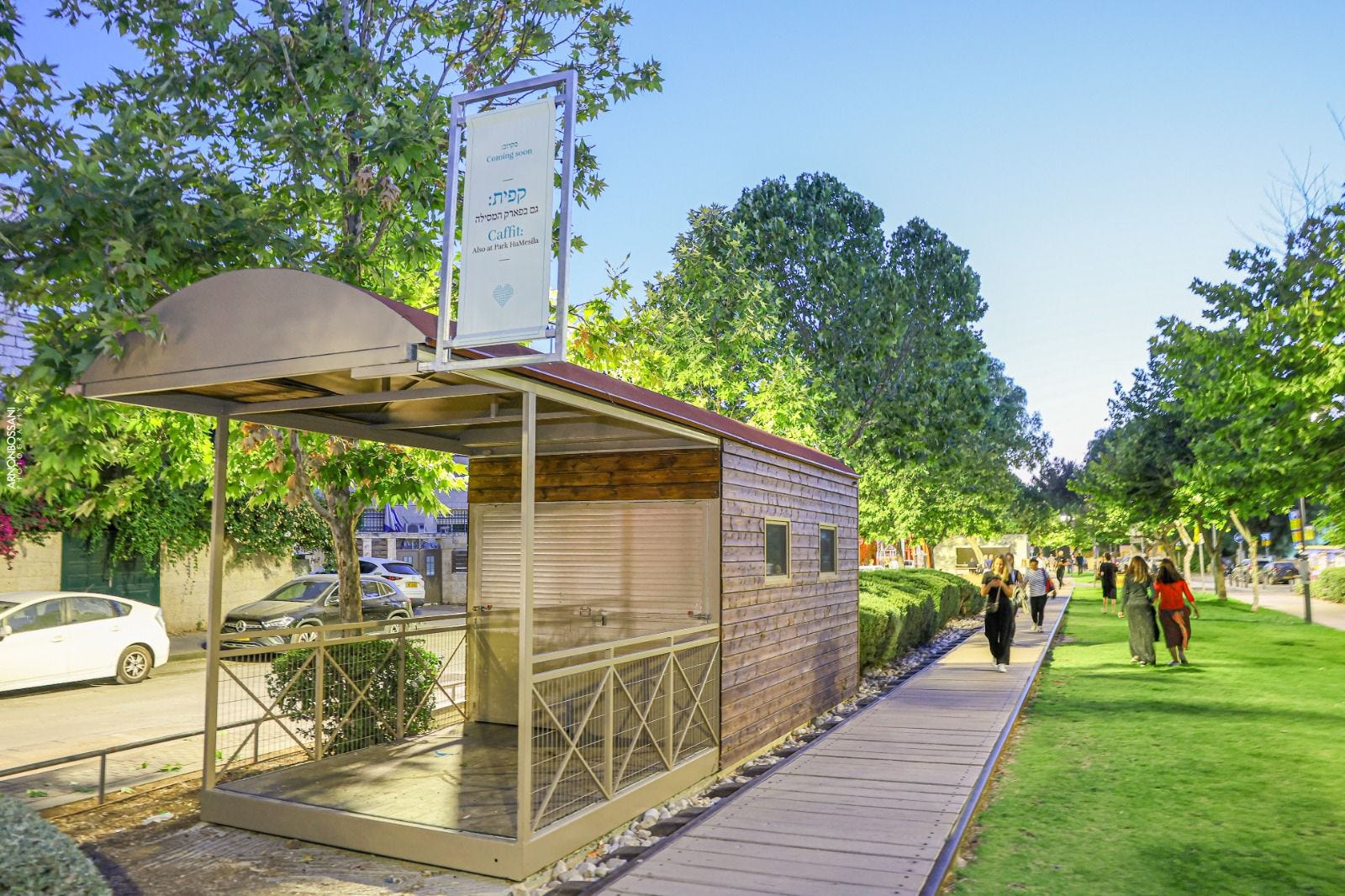
This is what Jewish sovereignty looks like.
Not endless war.
Not hatred.
Life.
Children laughing freely in their own capital.
Restaurants overflowing with conversation.
Cultures meeting without fear.
History preserved instead of erased.
Every tree, every café, every playground, every bicycle rolling down that old railway corridor declares something profoundly important:
The Jewish people are still here.
The Nazis built railways believing they were carrying the Jewish people toward extinction.
Instead, eighty years later, Jewish children ride scooters over old railway lines in the capital of the Jewish state.
That is history’s greatest failure for Hitler and greatest victory for the Jewish people.
After our walk, we ended the evening at Sushi Rehavia, and it was one of those meals that quietly reminds you why Jerusalem’s food scene has become world-class.
The fish was impeccably fresh. Every roll arrived beautifully presented without feeling overly pretentious. The combinations balanced traditional Japanese technique with just enough Israeli creativity to make each bite interesting rather than gimmicky. Portions were generous, the ingredients tasted vibrant, and by the time we finished, nobody at our table had room for dessert, which is probably the highest compliment a family dinner can earn. Humans have an astonishing ability to order “just a few rolls” and somehow produce enough sushi to feed a small diplomatic delegation.

As we walked back toward the car, the food trucks lining the Railway Park were still buzzing with people. We never made it there this time, but that simply gives us another reason to return. Sometimes the best travel experiences are the ones that leave something undiscovered.
Jerusalem has countless famous places. The Western Wall. Mount Herzzl. Old City of Jerusalem.
But if you really want to understand modern Israel, spend an evening in the German Colony.
Walk the railway.
Read the history.
Listen to the conversations around you.
Watch Jewish families, Arab families, Christian visitors, religious Israelis, secular Israelis, tourists from every continent, all sharing the same public space.
Then remember another set of railway tracks built during that same terrible era.
One civilization used railways to transport people toward death.
The other transformed its railways into a place where people gather to celebrate life.
Steel tracks never determine history.
The civilization that lays them does.
Thank you for sharing the beauty of Israel with those who can't or won't see it. Happily, my wife and I have been living here for the past 16 years and get to live in Israel's beauty.
Congratulations on an outstanding essay, which drives home the point that technologies are double-edged swords that can be used for good or evil, and that it’s our moral compass that determines our choice of those two alternatives.
That’s the philosophy behind the somewhat controversial assertion of the National Rifle Association that guns don’t kill people; people kill people. While it is widely deplored, from this perspective, it is nevertheless true.
Almost any technology can be weaponized, from water to acid to hammers, and of course, guns and nuclear technologies.
It is human nature played out in man’s inhumanity to man that we really need to work on and perfect, and the way to do that is more through the pursuit of virtue and constructive morality rather than limitations on technology that could benefit us as much as they can harm us.