


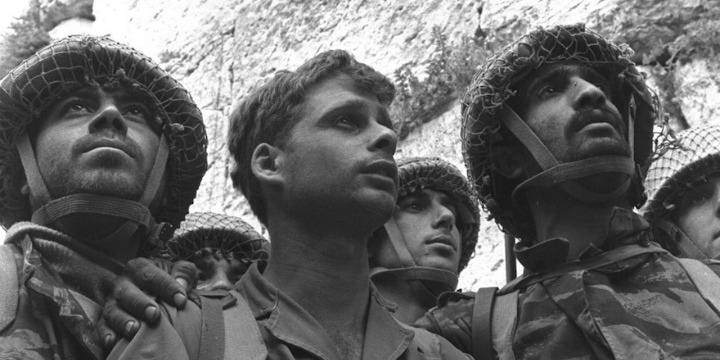
“Har HaBayit BeYadeinu”
There are moments in history that belong to one nation.
Then there are moments that belong to all of humanity.
The moon landing.
The fall of the Berlin Wall.
The liberation of Auschwitz.
And then there was a crackling military radio transmission that lasted barely a few seconds.
No orchestra.
No prepared speech.
No cameras carefully arranged for history.
Only the exhausted voice of an Israeli commander speaking into a battlefield radio in the middle of a war that Israel had not wanted but could not afford to lose.
“Har HaBayit BeYadeinu.”
“The Temple Mount is in our hands.”
Three thousand years of Jewish history fit inside those four Hebrew words.
To understand why millions of Jews still become emotional hearing that sentence nearly sixty years later, you have to understand what came before it.
For almost two thousand years, the Jewish people lived as strangers in lands that were never truly home.
Empires rose.
Empires collapsed.
Kings crowned themselves.
Kings disappeared into history.
Borders shifted endlessly.
Yet one thing never changed.
At every Passover Seder...
At the conclusion of every Yom Kippur...
At weddings...
At funerals...
In whispered prayers from Morocco to Poland, from Yemen to Lithuania, from Ethiopia to New York...
The same words echoed through every generation.
“Next year in Jerusalem.”
Not Paris.
Not London.
Not Berlin.
Jerusalem.
Children learned to pray toward a city many would never see.
Parents told stories of stones they had never touched.
Grandparents died believing that perhaps their grandchildren would return even if they never could.
It was the longest homesickness in human history.
Then, in June 1967, everything changed.
Israel was nineteen years old.
The nation was surrounded.
Egypt closed the Straits of Tiran.
Arab armies mobilized.
Radio broadcasts promised Israel’s destruction.
Mass graves were quietly prepared.
The memory of the Holocaust was only twenty-two years old.
The Jewish people knew exactly what extermination looked like.
When war erupted, Israel fought not for conquest.
It fought because losing meant there might not be another chance.
For three desperate days, some of the fiercest fighting took place in Jerusalem.
Jordanian forces occupied the eastern half of the city, including Judaism’s holiest sites.
Israeli paratroopers fought house by house, alley by alley, climbing through streets that had witnessed prophets, kings, pilgrims, crusaders, conquerors, and empires.
Many never reached the end.
Those who survived eventually arrived at the Lions’ Gate.
Beyond it waited history.
Then came the order.
Advance.
The soldiers ran through the narrow stone streets of the Old City.
Nobody knew exactly what waited around the next corner.
The fighting had not completely ended.
Snipers still threatened from rooftops.
Every doorway carried danger.
Then suddenly...
The alley opened.
Before them stood the Western Wall.
For the first time since 1948...
For the first time in nineteen years...
For the first time under Jewish sovereignty in nearly two millennia...
Israeli soldiers stood before the last remaining retaining wall of the Second Temple.
Many had never seen it.
Many had grown up hearing about it from grandparents who spoke of Jerusalem with tears in their eyes.
Battle-hardened paratroopers who had spent days under relentless fire removed their helmets.
Some instinctively placed their hands on the ancient stones.
Others began to cry.
Not politely.
Not quietly.
They wept with the full weight of generations standing behind them.
At that very moment, Colonel Mordechai Gur lifted his radio.
He did not deliver a polished speech.
He did not realize that schoolchildren would memorize his words for generations.
He simply reported what his eyes could scarcely believe.
“Har HaBayit BeYadeinu.”
“The Temple Mount is in our hands.”
History stopped.
Somewhere in Israel, families huddled around radios froze in place.
Mothers cried.
Holocaust survivors cried.
Children who did not fully understand why their parents were crying cried too.
Across the Jewish world, those four Hebrew words spread faster than any newspaper ever could.
Synagogues erupted in prayer.
Communities embraced.
For one extraordinary moment, Jews separated by continents felt as though they were standing together beneath the same Jerusalem sky.
Soon afterward, Chief Rabbi Shlomo Goren walked to the Wall carrying a Torah scroll and a shofar.
He recited the Shehecheyanu, the blessing thanking God for allowing us to reach this moment.
Then he lifted the ram’s horn.
Its ancient sound echoed across stones that had not heard a Jewish shofar in generations.
Imagine that sound.
Not merely as a note.
As history exhaling.
For centuries, enemies had tried to erase the Jewish people.
Babylonians.
Romans.
Crusaders.
Inquisitors.
Cossacks.
Nazis.
Every generation produced someone convinced Jewish history was finally over.
Yet there they stood.
Not as refugees.
Not as exiles.
Not asking permission to enter Jerusalem.
But as the defenders of a sovereign Jewish state.
That is why these moments matter.
Not because Jews conquered someone else’s holy place.
But because the world’s oldest surviving people returned to the city where their story began.
The Western Wall did not suddenly become holy in 1967.
It had always been holy.
What changed was that Jewish children could once again approach it without barbed wire, without foreign soldiers, without wondering whether the next generation would ever be allowed to return.
Today, millions visit the Wall every year.
Some come to pray.
Some come to remember.
Some come simply because history seems impossible until you touch those stones.
You can still see young soldiers standing quietly with a hand against the Wall before returning to their bases.
You can still watch elderly Holocaust survivors kiss the stones through tears.
You can still hear dozens of languages spoken in the plaza below.
Hebrew.
English.
French.
Russian.
Spanish.
Amharic.
The languages of exile.
Gathered at last in the language of home.
Perhaps that is the true meaning of those four famous words.
“Har HaBayit BeYadeinu.”
They were never just a military report.
They were the end of an exile.
The answer to two thousand years of prayer.
The fulfillment of words whispered by generations who never lived to see their dream become reality.
History remembers great battles.
The Jewish people remember four words.
Because sometimes four words can carry the weight of three thousand years.
Har HaBayit BeYadeinu.
The Temple Mount is in our hands.
And with those words, the heart of Jerusalem began beating in Jewish hands once more.
This piece is educational, inspirational and for me, emotional. And this Polynesian stands with Israel and the Jewish people all the way. Nothing can convince me otherwise.
Alil our lands in JEWISH hands.
1 STATE 🇮🇱.
No more ' paddycake ' playing
with JEW haters and kapo,
they are not to EVER
be trusted.