


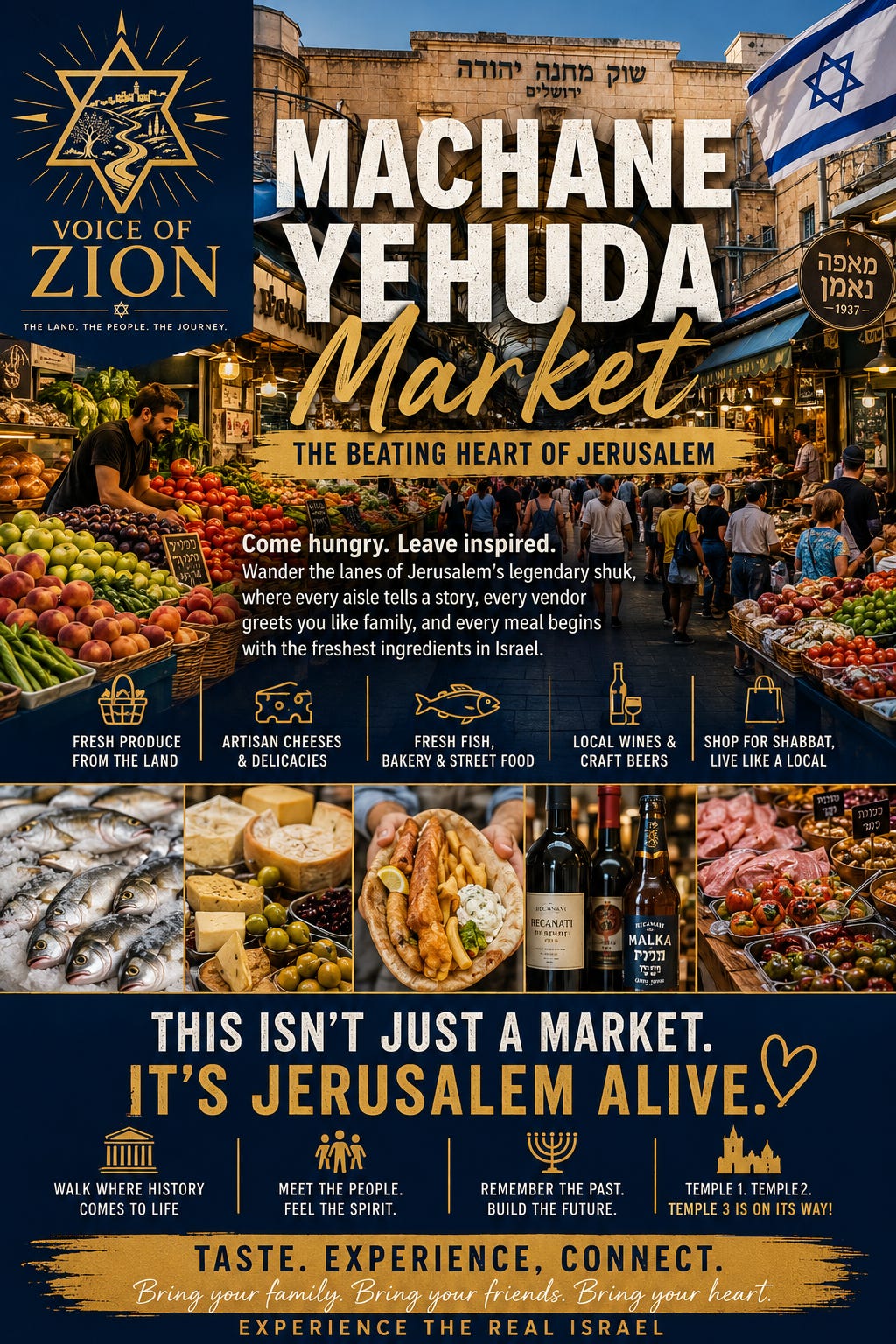
You can learn more about Israel in two hours at Machane Yehuda than in a semester of Middle Eastern politics.
Forget the headlines.
Go buy a peach.
This morning I walked into Jerusalem’s market with an empty backpack and a shopping list for Shabbat. A few hours later I walked out carrying fruit, vegetables, wine, beer, fish, enough dairy to feed an army, and a reminder that being Jewish has never been about choosing between joy and memory. Somehow we’ve always carried both.
Machane Yehuda doesn’t ease you in. It grabs you by the shirt.
One vendor insisted I taste his cherries. Another cut open a melon because he wanted to prove it was sweeter than the stall across the aisle. A woman selling olives asked where I lived before I even had time to ask about the price. Five minutes later we were talking about Aliyah, Arizona, and why Jerusalem somehow convinces people they’ve known each other for years.
Only in Israel do you leave with groceries and three new friends.
The produce is almost offensive in how good it is.
Tomatoes actually smell like tomatoes. Peaches drip down your wrist before you’ve finished the first bite. Herbs perfume the entire aisle. Figs, grapes, apricots, peppers, eggplants, cucumbers... every stand looks like someone emptied the Promised Land onto a wooden table and forgot to leave room for the customers.
I loaded my bags anyway.
Shabbat waits for no one.
Next came the wine.
Israeli wine for Kiddush. A few beers for later. Good bread. Fresh cheeses. Salads made that morning. Cold dishes packed into little containers that somehow never survive until Saturday because someone in the house always “just wants one taste.”
Then I made what may have been the easiest decision of the day.
Fish and chips.
Hot. Crispy. Fresh. No foam. No artistic drizzle. No chef explaining the emotional journey of the potato.
Just fantastic fish.
Normally I’d have wandered straight to the butcher afterward.
That smell should probably be illegal.
Brisket. Ribeye. Lamb. Sausages. If heaven has a barbecue, I’m reasonably confident it’ll look like a Jerusalem butcher shop on a Thursday afternoon.
But we’re in the Nine Days.
For Jews, these are the days leading up to Tisha B’Av, when we remember the destruction of the First Temple by Babylon and the Second Temple by Rome. For nearly two thousand years we’ve marked this season by turning the volume down. Many of us don’t eat meat or drink wine except on Shabbat. Weddings stop. Celebrations become quieter. The point isn’t to punish ourselves.
It’s to remember.
Civilizations disappear when they lose their memory.
The Jewish people survived because we refused to.
Every summer we deliberately interrupt our own happiness long enough to remember what was lost. We remember Jerusalem in flames. We remember exile. We remember that there was once a House standing on that mountain where Jews from every corner of the land came together.
Memory isn’t a burden.
It’s part of who we are.
So today I happily stuck with fish, dairy, vegetables, fruit, and enough fresh food to make Shabbat feel like Shabbat.
The butcher caught my eye as I walked past.
I nodded.
He nodded back.
We both know this arrangement is temporary.
Once Tisha B’Av passes, we’ll be reunited. There will be brisket. There will be steak. There may be excessive amounts of steak. Human beings make many questionable decisions. Loving meat has never been one of mine.
But today wasn’t about what I wasn’t eating.
It was about what I was experiencing.
Because here’s the remarkable thing.
I spent the morning shopping in the capital of the Jewish state, speaking Hebrew, preparing for Shabbat, surrounded by Jews who came home from more than a hundred countries, all while remembering Temples destroyed nearly two thousand years ago.
Most nations separate history from daily life.
Israel cooks dinner with it.
That’s what struck me as I walked back through the market carrying bags that seemed much heavier than when I’d arrived.
The Jewish story doesn’t erase grief.
It carries it.
It doesn’t get trapped in mourning.
It builds anyway.
The First Temple was destroyed.
The Second Temple was destroyed.
We have never forgotten either.
And yet here we are.
Jerusalem is alive.
The markets are overflowing.
Children run through streets their ancestors could only dream of seeing again.
Shabbat is coming.
History isn’t over.
Neither are we.
And if Jewish history has taught us anything, it’s this:
We don’t stay in exile forever.
We always find our way home.
The Fish and chips place has always been our favorite. Machane Yehuda is between the Central Bus station and where I took my Ulpan classes. I always had to detour through Machane Yehuda just to immerse myself in the atmosphere. What an experience.
Mentioning specific foods in Israel brings back fond memories. Breakfasts at hotels are a veritable feast. I’d never seen such an array of breads and croissants anywhere in my life! I think besides the chocolate ones, my favorite were the pistachio! After my first taste of a sweet cherry tomato, I was hooked! I’ve picked them fresh in Oregon, but the flavor with no hint of acidity couldn’t be beat in Israel. Yes, Israel being a truly melting pot of cultures offers such a variety of foods to try and enjoy! Thanks for bringing back lovely memories of the narrow streets of Jerusalem alive with vendors and people!