


They land at Ben Gurion Airport, collect their luggage, climb aboard a bus or rental car, and point Google Maps toward Jerusalem.
Forty-five minutes.
That’s all the screen says.
Forty-five ordinary minutes.
Except there is nothing ordinary about this road.
As you leave the airport behind, the coastal plain slowly gives way to rolling hills. The Mediterranean humidity fades. Olive trees begin to replace office buildings. The road starts to climb, almost imperceptibly at first, then with growing determination toward the mountains of Judea.
If these hills could speak, they would not whisper.
They would weep.
Long before highways, before guardrails, before tunnels carved through the rock, armies marched this way. Egyptian pharaohs. Assyrian kings. Babylonian conquerors. Roman legions carrying the menorah stolen from the Temple. Crusaders bearing crosses. Muslim armies carrying banners. Napoleon’s soldiers. British convoys. Ottoman patrols.
Every empire that wanted Jerusalem eventually discovered the same truth.
You cannot reach the Holy City without first climbing these hills.
History has been fighting over this road for nearly four thousand years.
Then came 1948.
The British withdrew.
The State of Israel was declared.
Within hours, five Arab armies invaded from every direction.
Jerusalem became the prize.
But Jerusalem had a problem.
Almost one hundred thousand Jews lived inside the city, and nearly all of their food, water, medicine, fuel, and ammunition depended on one narrow road from the coast.
This road.
The one your rental car is quietly cruising today with air conditioning and your favorite playlist.
Back then there were no comfortable rest stops.
There were ambushes.
The surrounding hills became killing grounds.
Arab forces controlled the heights above the highway. Every Jewish convoy attempting to reach Jerusalem could be seen from miles away. Trucks carrying flour, milk, medical supplies, and desperately needed ammunition became targets before they even reached the next bend.
Drivers knew many would never return.
They drove anyway.
Not because they were fearless.
Because an entire city was waiting.
Imagine loading a truck knowing that somewhere around the next corner someone intends to kill you.
Then imagine turning the key anyway.
That is courage.
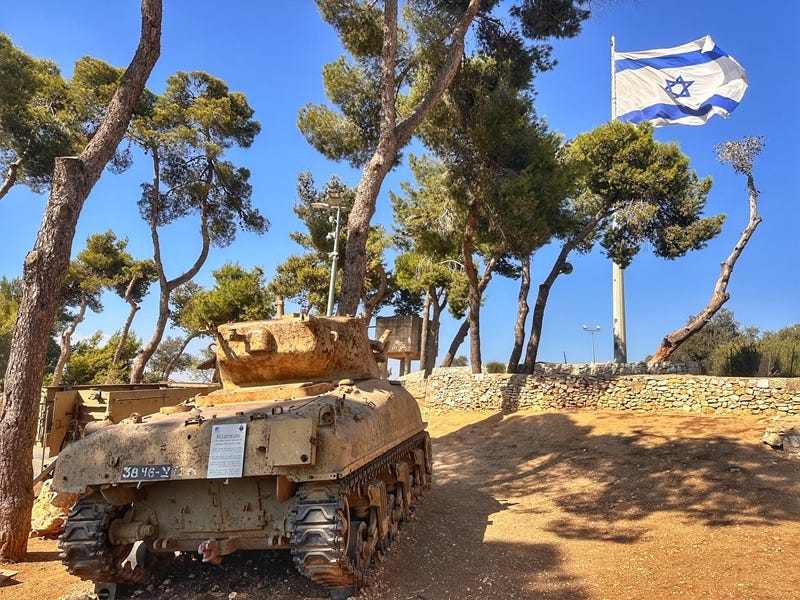
As you drive today, look carefully toward the hills.
You will notice something that seems almost impossible.
Burned-out armored vehicles.
Rusting steel.
Scarred by bullets.
Twisted by explosions.
Left exactly where they fell.
They are not forgotten wreckage.
They are memorials.
Each one represents men and women who believed Jerusalem was worth dying for.
Not for conquest.
Not for glory.
For survival.
Without those convoys, Jerusalem could have starved.
Without Jerusalem, the newborn State of Israel may never have survived its first months.
Those silent vehicles beside the road are not monuments to war.
They are monuments to sacrifice.
Israel could have hauled them away decades ago.
Painted over history.
Built shopping centers.
Pretended none of it happened.
Instead, they remain where they stood their final watch.
Every Israeli child who travels this road asks the same question.
“What happened to those trucks?”
Every generation receives the answer.
And every generation understands that freedom was purchased by people whose names most of the world will never know.
Eventually, Israeli forces broke the siege.
Engineers carved an improvised route through the mountains.
It became known as the Burma Road, named after the famous supply route in Asia during the Second World War.
It was rough.
Narrow.
Dangerous.
At times, supplies had to be unloaded from trucks, carried by hand or by mule across sections too steep for vehicles, and loaded again on the other side.
It was exhausting.
It was inefficient.
It saved Jerusalem.
Sometimes history turns not on grand speeches or famous generals, but on anonymous men lifting sacks of flour up a rocky hillside because a city refuses to surrender.
That is the story of Israel.
Not miracles descending from heaven.
Ordinary people doing extraordinary things because there was no one else left to do them.
When you finally reach Jerusalem, something remarkable happens.
The air changes.
The light changes.
Even those who arrive without faith often find themselves unexpectedly quiet.
Perhaps it is because no city on earth has been loved so deeply, mourned so bitterly, or defended so fiercely.
Perhaps it is because every stone seems to remember.
The next time someone dismisses Israel as a political argument or a headline on the evening news, I wish they would drive this road.
Not quickly.
Slowly.
With the windows open.
Past the memorials.
Past the burned convoys.
Past the hills that once echoed with gunfire and now echo with children laughing on school trips.
Only then can you begin to understand.
Israel was not handed to the Jewish people.
It was carried.
Sometimes on tired shoulders.
Sometimes in armored trucks.
Sometimes in coffins.
The road from Ben Gurion Airport to Jerusalem is only forty-five minutes long.
The journey it represents is nearly four thousand years.
And every kilometer whispers the same simple truth:
There are places in this world that are worth building.
There are places worth praying for.
And, when history demands it, there are places worth everything.
The Road to Jerusalem-- a life line for Jerusalem, built with Jewish blood. G-d bless those brave souls who shed their blood for Jerusalem, for Israel.
Thank you, Yonah, for another valuable history lesson.
Am Yisrael Chai
Beautiful piece....Thank you.
From Samoa, South Pacific.