


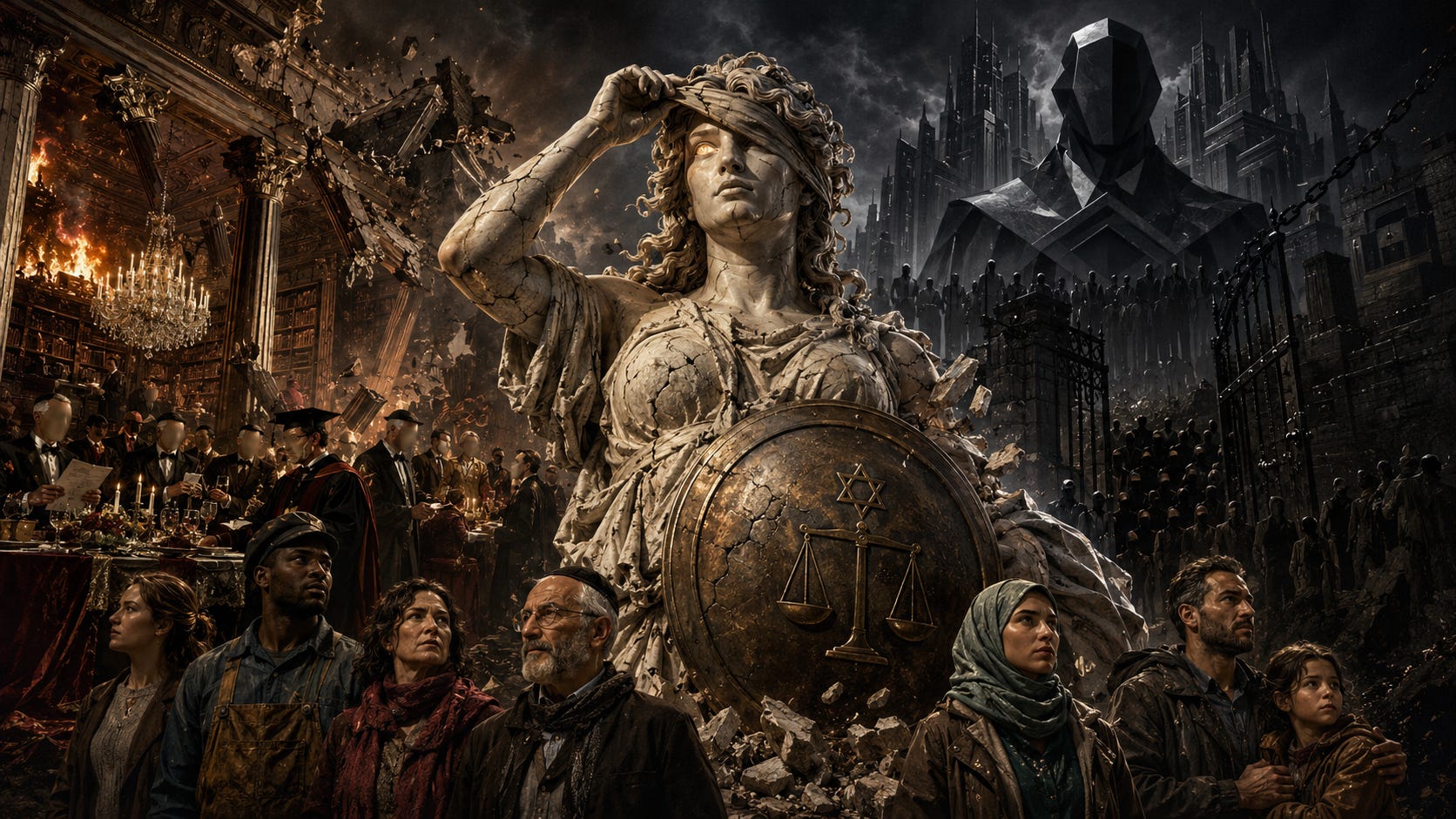
The rightward turn is not a mystery.
It is an invoice.
History has presented the bill for half a century of asymmetrical tolerance, borderless sentimentality, epistemological vandalism, institutional cowardice and elite contempt. The people forced to pay it—through fractured communities, silenced speech, collapsing trust and the slow criminalization of common sense—have begun to revolt.
This is not the resurrection of some sepia-toned conservatism, preserved in mothballs between the family Bible and a portrait of Ronald Reagan. Nor is it merely an electoral spasm caused by inflation, immigration or the algorithmic derangement of social media.
It is something much larger.
It is the political consequence of a civilization whose liberal elite lost the moral courage to defend liberal civilization.
The modern right did not become mainstream because millions of people suddenly rejected liberty. It became mainstream because the institutions calling themselves liberal began treating liberty as a suspicious activity.
The last liberal became a conservative when he discovered that free speech was now “harm,” borders were “violence,” equal treatment was “oppression,” self-defense was “escalation,” terrorism was “resistance,” Jewish sovereignty was “colonialism,” and truth itself was merely a vulgar prejudice held by people insufficiently educated to understand why their own eyes were lying to them.
He did not abandon liberalism.
Liberalism abandoned him.
The Hidden Foundations of Freedom
The great error of the modern liberal elite was to imagine that liberal democracy could survive as pure procedure.
Pass the correct laws. Design the correct institutions. Establish the correct courts. Write the correct rights into the correct documents. Then humanity, relieved of its primitive loyalties, would float serenely into a post-national future administered by experts, international agencies and impeccably credentialed moral supervisors.
This was always a fantasy.
Liberalism was never self-sustaining. It lived on moral capital accumulated before liberalism itself: habits of restraint, family obligation, civic trust, religious conscience, national loyalty, historical memory and the willingness to sacrifice private interest for a public good.
The German constitutional thinker Ernst-Wolfgang Böckenförde formulated the dilemma with brutal clarity: the liberal secular state depends upon conditions it cannot itself guarantee.
A constitution can announce freedom. It cannot manufacture the character required to preserve it.
A parliament can record votes. It cannot force the defeated to regard the victor as legitimate.
A court can protect religious liberty. It cannot create a culture in which religious factions willingly accept that their doctrines do not govern everyone.
A free press can circulate information. It cannot survive if journalists decide their function is not to investigate reality but to protect the public from unauthorized interpretations of it.
Every liberal society rests upon a pre-liberal covenant: we will disagree without destroying one another; we will lose without reaching for violence; we will tolerate your conscience if you tolerate ours; and none of us will use liberty merely as a ladder to power before kicking it away.
That covenant is not sentimental.
It is the load-bearing wall of the entire democratic order.
John Locke understood that government derived legitimacy from consent. John Stuart Mill understood that truth requires collision with error. Tocqueville understood that democracy depends on customs, associations and moral habits that government cannot replace. Burke understood that society is not a temporary business arrangement among the living but a partnership between the dead, the living and the unborn.
These were not interchangeable arguments. Together, however, they disclosed the same terrible fact: freedom requires a particular kind of human being living inside a particular kind of culture.
The modern elite wanted the freedom without the culture, the rights without the duties, the harvest without the soil.
Then it expressed astonishment when the ground turned to dust.
How Liberalism Became Anti-Liberal
Classical liberalism began with epistemic humility: no ruler, priest, professor or majority possesses enough certainty to silence everyone else.
The new liberalism begins with epistemic arrogance: enlightened institutions already know which opinions advance justice, and therefore disagreement with those opinions is evidence of moral or psychological defect.
This is not an evolution of liberalism.
It is an inversion.
The transformation occurred through the convergence of two intellectual forces that appeared, superficially, to be enemies.
The first was technocratic managerialism. It regarded the nation as an inefficient administrative unit, the citizen as a bundle of preferences, the border as friction, politics as a technical problem and government as a delivery mechanism for outcomes designed by people who attended the correct universities.
The second was identitarian radicalism. It rejected the individual as the basic moral unit and replaced him with the demographic category. It taught that language was power, objectivity was camouflage, universal principles concealed domination and moral authority flowed from one’s position inside an inherited hierarchy of oppression.
The technocrat supplied the machinery.
The radical supplied the theology.
Together they created the most suffocating political hybrid of the modern West: a bureaucracy that speaks like an activist and an activist class empowered like a bureaucracy.
This new regime does not need to abolish elections or send police into every home. Its preferred instruments are softer, more pervasive and therefore more difficult to resist: accreditation, professional codes, human-resources investigations, reputational destruction, algorithmic suppression, compelled declarations and the quiet conversion of every institution into an ideological checkpoint.
The citizen remains formally free while becoming socially unemployable.
No censor announces himself. A “trust and safety” specialist adjusts visibility.
No inquisitor asks whether you believe. A compliance form asks whether you are aligned.
No commissar arrests the heretic. A committee explains that his continued presence makes vulnerable colleagues feel unsafe.
Tyranny has learned to use therapeutic vocabulary.
The old liberal asked power to justify itself.
The new liberal asks the citizen to justify himself before power.
The old liberal defended the dissenter because majorities could be wrong.
The new liberal disciplines the dissenter because disagreement might weaken the approved majority narrative.
The old liberal believed that human beings possessed rights regardless of identity.
The new liberal arranges humanity into a moral caste system and calls the arrangement equity.
It turned moral intelligence into a seating chart.
The Elite Is Not a Conspiracy. It Is Worse.
The liberal elite is not a secret committee meeting beneath Davos to coordinate the destruction of civilization over sparkling water and ethically sourced canapés.
The reality is more banal and more dangerous.
It is a distributed institutional class whose members share the same credentials, read the same publications, reward the same language, fear the same accusations and derive status from performing the same moral gestures.
They do not need to conspire. Incentives coordinate them.
A professor advances by identifying a previously unnoticed oppression. An activist organization raises money by magnifying a crisis. A corporation purchases moral absolution by adopting activist language. A journalist gains prestige by translating political disagreement into a drama of victim and oppressor. A bureaucrat expands authority by finding another sphere of life requiring expert supervision.
Each actor behaves rationally within the system.
The collective result is insanity.
This is how ideological escalation occurs without an identifiable dictator. Yesterday’s radical claim becomes today’s institutional baseline. Once absorbed, it can no longer provide distinction, so the prestige economy demands a more extreme claim tomorrow.
Moderation becomes career suicide because moral status is awarded to the person who discovers the greatest hidden evil, not to the person who asks whether the alleged evil exists.
The elite became intoxicated by its own language because it rarely paid the price of its abstractions.
Those who celebrated porous borders generally lived behind gates.
Those who romanticized disorder did not depend upon the neighborhood shop destroyed by it.
Those who treated policing as an embarrassing relic did not wait forty minutes for help.
Those who described national identity as primitive maintained ferocious loyalty to their own professional class.
Their cosmopolitanism was not the absence of tribe.
It was tribalism with airport lounges.
They converted privilege into proof of virtue and then lectured people bearing the consequences of their ideas about compassion.
This was not simply hypocrisy.
It was moral expropriation.
The Suicide of Asymmetrical Tolerance
A liberal order can survive profound disagreement. What it cannot survive is one-way tolerance.
Tolerance is reciprocal or it is surrender.
That principle should be obvious. Yet the contemporary elite made reciprocal obligation itself taboo. It demanded unlimited openness from liberal civilization while refusing to demand even minimal liberalism from movements entering, operating within or openly opposing it.
Here the confrontation with Islamism became decisive.
The distinction must be made with absolute precision because moral seriousness begins with intellectual discrimination.
Islam is a religion containing nearly two billion people, countless theological traditions and every conceivable degree of belief, doubt, observance and political opinion.
Islamism is a political ideology that seeks to subordinate individual conscience, civil law and democratic equality to religious supremacy.
A Muslim who believes in constitutional government, equal citizenship and freedom of conscience belongs inside the liberal democratic covenant.
An Islamist who regards those principles as temporary obstacles does not become liberal merely because criticizing him makes Western academics uncomfortable.
The most courageous enemies of Islamism have often been Muslims: Iranian women confronting compulsory veiling, Arab writers resisting censorship, reformist clerics challenging fanaticism, secular dissidents, gay Muslims, apostates and ordinary believers who want faith without theocracy.
The liberal elite’s refusal to distinguish these people from Islamists is not tolerance.
It is an insult.
It collapses hundreds of millions of autonomous human beings into a single political identity and then calls anyone who notices the difference a racist. It racializes a religion, infantilizes its adherents and grants its most reactionary representatives the authority to speak for everyone.
That is not multiculturalism.
It is colonial paternalism with a diversity office.
A liberalism that cannot protect a novelist, a woman, a Jew, a Christian, an atheist or a Muslim dissident from religious coercion is not liberalism. It is a public-relations department for its own extinction.
The alliance between the radical Western left and Islamism is frequently described as paradoxical. There is nothing paradoxical about it once one understands the underlying structure.
They do not share a destination.
They share an enemy.
The radical left sees Western civilization as an architecture of racial, capitalist, patriarchal and colonial domination that must be dismantled.
Islamism sees Western civilization as decadent, secular and spiritually corrupt territory that must eventually be subordinated.
One wishes to dissolve the house.
The other wishes to inherit the address.
Their temporary partnership is founded not on mutual affection but on convergent hostility toward the liberal nation-state, Western confidence and—most obsessively—Israel.
The progressive activist overlooks Islamist misogyny because acknowledging it would complicate the approved hierarchy of victimhood. The Islamist adopts the vocabulary of decolonization because it launders a supremacist project through the language of liberation.
Reaction does not become progressive because it changes languages.
Theocracy does not become emancipation because its victims are inconvenient to Western theory.
Fascism does not become anti-fascism because the fascist remembers to describe his enemy as a colonizer.
Yet the intellectual eunuchs of the modern academy have perfected the art of discovering “context” precisely where moral judgment is required.
They can identify seventy-three varieties of microaggression but cannot recognize a pogrom while watching it livestreamed.
Israel: The Fact That Shatters the Theory
Israel is the unforgivable fact at the center of this ideological crisis.
It is unforgivable because it ruins the categories.
The Jewish people are ancient and modern, indigenous and diasporic, Middle Eastern and European, religious and secular, wounded and sovereign. Israel contains the descendants of Holocaust survivors, Jews expelled or driven from Arab and Muslim lands, Ethiopian Jews, Soviet Jews and families whose roots in Jerusalem, Hebron, Safed and Tiberias reach backward through centuries.
The Jews cannot be neatly placed inside the crude postcolonial diagram because Jewish history predates the diagram, crosses its boundaries and exposes its intellectual poverty.
The Jew is white when his supposed privilege must be condemned.
The Jew becomes foreign when his belonging must be denied.
The Jew is indigenous nowhere and an intrusive settler everywhere.
He may be mourned at Auschwitz but condemned for refusing to build another Auschwitz in Israel.
The elite accepts the Jew most comfortably as a corpse.
A dead Jew can be memorialized, universalized and drained of political inconvenience. His suffering can become a museum exhibit about tolerance.
The armed Jew is another matter.
The armed Jew announces that memory has acquired sovereignty. That Jewish safety will no longer depend upon the intermittent decency of governments, mobs, kings, presidents, universities or fashionable political movements. That “Never Again” is not an annual ceremonial murmur.
It is a sovereign verb.
This is what anti-Zionism cannot forgive.
Not merely that Jews returned, but that Jews ceased asking permission to survive.
October 7 exposed the pathology with horrifying clarity.
The speed with which parts of the Western activist class moved from massacre to explanation, from explanation to justification and from justification to celebration was not an intellectual accident.
It was doctrine operating automatically.
The bodies had not been identified before the slogans arrived.
People who had spent years proclaiming that words were violence suddenly became metaphysically uncertain about whether torture, rape, kidnapping and the deliberate murder of families constituted violence when committed against Israelis.
They demanded “context” not to understand the crime but to dissolve the criminal’s agency.
That is one of the most repulsive features of the contemporary victimhood hierarchy: it grants limitless agency to the designated oppressor and no agency at all to the designated victim.
Israel is responsible for everything, including the choices of its enemies.
Palestinians, in this framework, are responsible for nothing, not even the murder of Israelis.
This is not solidarity with Palestinians. It is contempt for them. It treats an entire people as moral children, incapable of choice, strategy, fanaticism, courage, cruelty, compromise or responsibility.
Real respect demands agency.
Real compassion can condemn suffering without sanctifying those who manufacture it.
Real liberalism can defend Palestinian dignity without turning Hamas into an armed social-work organization.
But ideological liberalism can no longer make such distinctions. Its moral vocabulary has only two settings: oppressor and oppressed. Once the roles are assigned, facts become decorative.
Israel is guilty before it acts.
Its enemies are innocent after they kill.
That is not moral reasoning.
It is a secular theology of predestination.
The Right’s Complicity in the Collapse
The right should not congratulate itself too quickly.
It helped create the wasteland through which it now marches.
For decades, establishment conservatism reduced freedom to economics. It worshipped deregulation, shareholder value and consumer choice while treating culture as a secondary concern and national solidarity as an obstacle to efficiency.
It defended the market but forgot to defend the society in which markets operate.
It allowed factories, neighborhoods and civic institutions to disintegrate while pointing triumphantly at aggregate growth. It treated workers as interchangeable labor units, towns as obsolete coordinates and citizenship as an inconvenient distinction inside a global supply chain.
It confused a market economy with a market society.
The first is indispensable to freedom.
The second dissolves everything that cannot be priced.
A man is not free merely because he may choose among thirty streaming services while fearing that an honest sentence at work will destroy his livelihood.
A family is not flourishing because the national economy grew three percent while its community collapsed.
A country is not a hotel with a gross domestic product.
The post-Cold War right imagined that history had ended, markets would liberalize tyrannies and cultural institutions could be abandoned to the left because politics was fundamentally about tax rates.
It ceded the universities, media, civil service, arts, schools and language itself.
Then it seemed surprised when people educated by its opponents eventually governed the culture.
The new right emerged from the ruins of that failure as much as from the failure of the left.
It no longer asks only, “How large is the economy?”
It asks, “Whom does the economy serve?”
It no longer asks only, “Is the individual formally free?”
It asks, “Does he possess the cultural, familial and institutional conditions required to exercise freedom?”
It no longer assumes that any movement of capital, labor or information across borders must be beneficial because movement itself is efficient.
It asks whether the nation remains capable of governing itself.
This is the philosophical evolution that explains the right’s movement into the mainstream.
The old right defended order.
The libertarian right defended choice.
The new right is attempting—often chaotically—to defend the conditions under which order and choice can coexist.
It combines Burke’s reverence for inheritance, Mill’s defense of dissent, Tocqueville’s insistence upon civic association, Hobbes’s recognition that order precedes liberty and Orwell’s understanding that political freedom begins with the right to state the obvious.
It is an unstable synthesis. It contains national conservatives, classical liberals, religious traditionalists, populists, working-class voters, dissident feminists, anti-communist immigrants, Muslim reformers, Zionists, secular free-speech advocates and ordinary parents who never intended to join a counterrevolution but discovered that reality had been declared reactionary.
Sometimes this coalition barely agrees on the meaning of breakfast.
But it understands one thing the elite forgot:
Liberty requires architecture.
The Return of the Boundary
A boundary is not automatically an act of hatred.
It is the beginning of definition.
A free society distinguishes the citizen from the noncitizen, lawful conduct from coercion, religion from theocracy, immigration from invasion, compassion from capitulation, criticism from intimidation and peace from the temporary absence of resistance.
The contemporary elite treated every boundary as morally suspect because boundaries exclude.
Of course they exclude.
That is what makes them boundaries.
A legal system excludes lawlessness. A democracy excludes political violence. A home excludes uninvited entry. A definition excludes what the word does not mean. A civilization excludes practices incompatible with its continued existence.
The question is not whether society will exclude.
The question is what it will exclude, by what law and according to which moral principles.
The nation-state is not merely a bureaucratic container. It is the political scale at which democratic solidarity becomes possible. Citizens finance schools their children do not attend, defend towns they have never seen, accept election results they despise and support strangers in hardship because they recognize one another as participants in a shared national enterprise.
There is no democracy without a demos.
There is no welfare without a “we.”
There are no enforceable human rights without a government willing and able to enforce them.
Universal dignity is a moral truth.
Political responsibility is necessarily particular.
Humanity in the abstract does not patrol a street, protect a synagogue, rescue a hostage, maintain a court, collect a tax or defend a border.
Actual nations do these things.
The cosmopolitan who sneers at national loyalty is usually consuming security, law and prosperity produced by national loyalties he considers beneath him.
He is not post-national.
He is a parasite upon the nation.
Why the Public Finally Revolted
The public’s revolt is often described as irrational, emotional or populist—as though people require a doctorate in political philosophy before noticing that their rulers despise them.
They do not.
A worker does not need to read Foucault to understand that the meaning of words is being manipulated.
A mother does not need to read Böckenförde to know that a society unwilling to transmit its values will eventually lose them.
A Jewish student does not need a seminar on discourse analysis to recognize the difference between criticism and a crowd glorifying those who murdered Jews.
An Iranian woman does not need Western feminists to explain the liberating dimensions of the morality police.
Ordinary people may lack the elite’s vocabulary.
They do not lack perception.
What enraged them was not merely failure. Governments fail constantly. It was the compulsory humiliation of being ordered to praise the failure as virtue.
They were told that noticing the consequences of uncontrolled migration was xenophobia.
That distinguishing a man from a woman was hatred.
That expecting assimilation was cultural violence.
That prosecuting crime was oppression.
That loving their national inheritance was fascism.
That defending Israel from genocidal terrorists was complicity in genocide.
That their memories were misinformation, their concerns were phobias and their eyes were unreliable instruments contaminated by privilege.
Eventually, people reach the limit of coerced absurdity.
When every ordinary opinion is labeled extreme, “extremism” loses its power to frighten.
When every defender of borders is called fascist, the word fascist becomes evidence not of the defender’s wickedness but of the accuser’s intellectual bankruptcy.
When every objection is declared dangerous, danger becomes the official synonym for dissent.
The electorate did not move because it mastered a new philosophical theorem.
It moved because it was sick of being required to lie.
Reality became politically homeless.
The right offered it a chair.
The Danger Inside the Counterrevolution
But the right faces a test more severe than winning elections.
It must decide whether it intends to rescue liberal civilization or merely avenge itself upon the people who betrayed it.
Resentment is politically combustible. It can illuminate injustice or burn down judgment.
A movement organized around civilizational defense can decay into racial paranoia. A defense of borders can become blood mysticism. A demand for public order can become worship of force. A rebellion against bureaucratic censorship can become censorship wearing patriotic colors. A legitimate hatred of Islamist supremacy can degenerate into indiscriminate hatred of Muslims.
If that happens, the counterrevolution will have become another form of the disease it claims to cure.
The purpose is not to change which tribe controls the machinery of coercion.
The purpose is to dismantle the machinery of ideological coercion.
The standard cannot be whose boot is pressing upon the citizen’s throat.
The standard must be that no faction acquires the right to place it there.
A serious right must be merciless toward totalitarian ideas and scrupulous toward individual human beings. It must defend Muslims from collective guilt while confronting Islamism without apology. It must preserve borders without converting ancestry into destiny. It must protect public order without immunizing state abuse. It must defend tradition without sanctifying every injustice that happened to arrive before us.
It must possess the strength to identify enemies and the discipline not to invent them.
Otherwise it will not defeat identitarianism.
It will repaint it.
The Death of the Liberal Elite
The liberal elite is dying not because it lost an election but because it exhausted its claim to moral authority.
An elite can survive incompetence.
It cannot survive becoming ridiculous.
These people presented themselves as guardians of nuance and became incapable of making elementary distinctions. They confused mercy with the refusal to judge, openness with the abolition of boundaries, tolerance with submission, diversity with ideological uniformity and moral sophistication with endless hostility toward their own civilization.
They made a profession of “speaking truth to power.”
Then they became power and declared truth a form of violence.
They transformed universities from houses of argument into seminaries for an aristocracy of grievance. They turned journalism from an adversarial investigation of power into the emotional management of the public. They turned corporations into moral ventriloquists, governments into therapeutic prefectures and language into a minefield patrolled by people whose livelihoods depend upon discovering mines.
They taught a generation to experience contradiction as injury and inherited civilization as shame.
Then the world supplied an enemy that felt no shame at all.
Islamism looked upon the West’s moral confusion and understood immediately what the elite could not: a civilization ashamed of defending itself has already begun negotiating the terms of its surrender.
History will not describe this as compassion.
It will describe it as decadence with footnotes.
The Counterrevolution
The new dividing line is not simply left against right.
It is reality against ideology.
Reciprocal tolerance against unilateral disarmament.
Citizenship against demographic bookkeeping.
Universal law against hereditary innocence and hereditary guilt.
Democratic sovereignty against both theocratic supremacy and managerial oligarchy.
Moral agency against the infantilization of designated victims.
Civilizational confidence against the obscene vanity of self-erasure.
This is why the right is becoming mainstream.
Not because humanity has become more cruel, but because millions have realized that compassion without judgment is merely cowardice performing kindness.
Not because freedom has failed, but because freedom cannot survive among people unwilling to distinguish it from surrender.
Not because every conservative is wise, but because the institutions of liberalism became catastrophically foolish.
The liberal elite imagined that the greatest danger to freedom was the person who loved his nation too intensely.
It failed to notice the danger posed by people who did not love freedom at all.
So let the obituary be written.
The elite died as it lived: correcting the grammar of the man shouting “fire,” investigating him for alarmist language, explaining the historical grievances of the arsonist and congratulating itself on maintaining civility while the library burned.
But liberty did not die with it.
Liberty changed its political address.
It went where the forbidden distinctions could still be spoken.
Where a woman remained a woman.
Where a border remained a border.
Where terrorism remained evil.
Where the citizen remained more than a racial category.
Where the Muslim reformer could be defended against the Islamist.
Where the Jew was permitted not merely to be mourned, but to be armed.
Where Western civilization was understood not as innocent—it has never been innocent—but as worthy of preservation because it created the moral vocabulary by which its own sins could be exposed.
We did not move right because we stopped believing in liberty.
We moved because liberty arrived at our door, half-frozen and bloodied, expelled by the institutions that had inherited its name.
We opened the door.
Call that reactionary if you wish.
Reaction is what living tissue does when touched by flame.
The political right is no longer merely conserving the past.
It is staging a counterrevolution on behalf of reality itself.
And the most revolutionary word of our age—the word that will separate free men from frightened administrators, sovereign nations from managed populations and civilizations from their undertakers—is also the smallest.
No.
No, censorship is not safety.
No, theocracy is not diversity.
No, terrorism is not resistance.
No, national suicide is not compassion.
No, Jewish helplessness is not peace.
No, reality will not apologize for contradicting your theory.
The liberal elite mistook its will to disappear for moral superiority.
We will not follow it into oblivion.
We are not here to preserve its ashes.
We are here to seize freedom from its undertakers.
Absolutely outstanding! Its too bad that we don't hear more of this from the bimah rather than the wokee-dokee, kum-ba-yah nonsense we usually get.
Liberalism became a theology of hate fitting right in with Islamism, the commonality here is the moral collapse.