

There are journeys measured in miles.
Mine is measured in generations.
When people ask me why I moved to Israel, they expect a political answer.
They expect me to begin on October 7.
I don’t.
My story begins decades earlier, on another continent, in another country, during another chapter of history.
I was born in Johannesburg, South Africa, in 1982.
The South Africa of my birth was a nation standing between two worlds. Apartheid was entering its final decade. The wounds left by Sharpeville, Soweto, sanctions, political violence, and generations of mistrust still defined the national conversation. Democracy was coming, but no one knew what it would ultimately look like.
Johannesburg itself reflected those contradictions.
To the north stood prosperous suburbs with tree-lined streets, excellent schools, thriving businesses, and families who believed tomorrow would be better than today.
To the south lay communities struggling with poverty on a heartbreaking scale.
I grew up in the north.
I was privileged.
There is no virtue in pretending otherwise.
But privilege does not mean blindness.
I could see both South Africas.
As democracy arrived under Nelson Mandela, the world celebrated a remarkable political transformation.
It deserved to.
Every human being deserves dignity and equality before the law.
But democracy alone could not erase generations of inequality, poverty, mistrust, and violence.
As the years passed, another reality emerged.
Electric fences became ordinary.
Security gates became expected.
Armed response signs stood outside homes like another piece of garden furniture.
Parents taught their children to lock car doors before driving away from traffic lights.
Crime was no longer the exception.
It became part of daily life.
One memory has never left me.
A friend’s uncle arrived home one afternoon.
He never made it through his front door.
The men who murdered him wanted his BMW.
That was all.
Statistics never changed me.
Faces did.
That face still does.
Yet despite everything, I loved South Africa.
I still do.
It gave me resilience.
It gave me strength.
It taught me never to take civilization for granted.
But South Africa gave me something even greater.
It gave me my Jewish identity.
Few people realize that South Africa became home to one of the greatest Litvak Jewish communities in the modern world. Families fleeing Lithuania and the Russian Empire arrived carrying little more than Torah, education, discipline, and hope. They built schools, synagogues, charities, businesses, and communities whose influence far exceeded their numbers.
Their legacy shaped me.
The Litvak tradition values careful thought over slogans, discipline over emotion, learning over popularity, and responsibility over excuses.
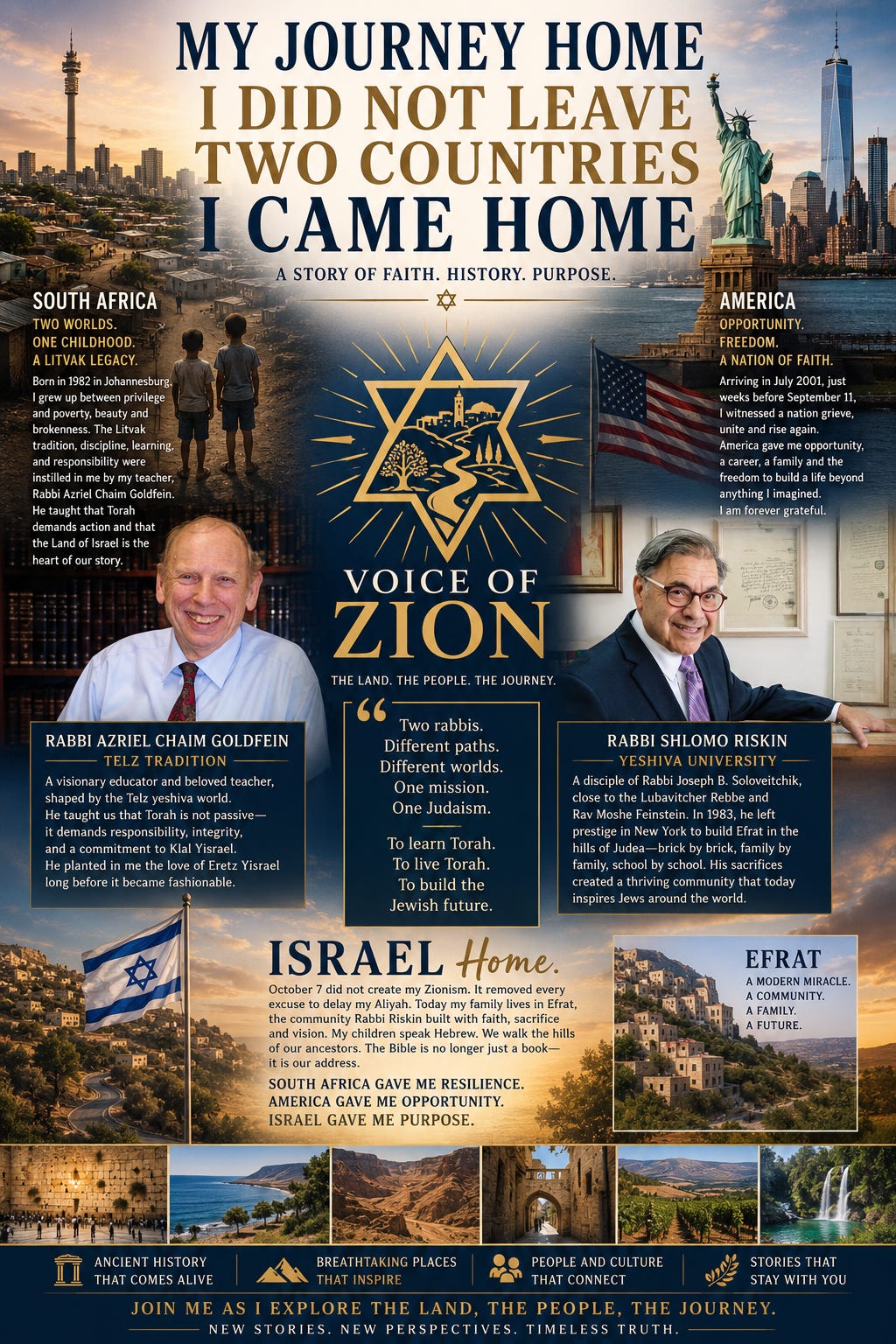
I was blessed to study under Rabbi Azriel Chaim Goldfein, a product of that remarkable world and deeply influenced by the Telz tradition.
Rabbi Goldfein never taught Judaism as something passive.
Torah demanded action.
Learning demanded responsibility.
Privilege demanded service.
Memory demanded purpose.
He taught us that every Jew inherited not only a history but a mission.
Most importantly, he planted within many of us a love for the Land of Israel long before it became fashionable to speak about Zionism.
Long before social media.
Long before October 7.
Long before Israel dominated the headlines.
A seed had already been planted.
Then, in July 2001, my mother made one of the bravest decisions of her life.
She packed our belongings, gathered my brother, my sister, and me, and moved us halfway across the world to the United States.
America welcomed us.
Only weeks later, on September 11, everything changed.
I had barely begun discovering my new country when I watched smoke rise from the Twin Towers.
I watched firefighters run into buildings everyone else was trying to escape.
I watched a nation mourn together.
Pray together.
Stand together.
As a brand-new immigrant, I saw something extraordinary.
America reminded the world that freedom is never free.
Over the next twenty-three years, America gave me opportunities beyond anything I had imagined.
I built a career.
I raised a beautiful family.
My children attended Jewish day schools.
We celebrated Shabbat.
We belonged to vibrant Jewish communities.
By every conventional measure, I had achieved the American dream.
I remain profoundly grateful for everything America gave me.
But success and belonging are not always the same thing.
People often ask whether October 7 changed me.
The answer is both yes and no.
It changed my timetable.
It did not change my heart.
I often describe myself as an October 6 Jew.
An October 8 Jew discovered Israel because of October 7.
The massacre awakened something dormant.
The world’s oldest hatred revealed itself once again.
Israel suddenly became indispensable.
I understand that awakening.
But I am not an October 8 Jew.
I am an October 6 Jew.
I loved Israel before the massacre.
Before the headlines.
Before the protests.
Before the hashtags.
My Zionism was never built on fear.
It was built on covenant.
On Abraham leaving everything familiar because God called him to this land.
On Isaac.
On Jacob.
On King David establishing Jerusalem as Israel’s capital three thousand years ago.
On generations of Jews who ended every Passover and every Yom Kippur with the same impossible prayer:
“Next year in Jerusalem.”
October 7 did not create my Zionism.
It removed every remaining excuse for postponing my Aliyah.
That journey eventually brought me to Efrat.
To understand why that matters, you have to understand another remarkable rabbi.
Rabbi Shlomo Riskin could have remained one of America’s most influential Modern Orthodox rabbis. A graduate of Yeshiva University and a distinguished disciple of Rabbi Joseph B. Soloveitchik, he also maintained meaningful relationships across the Orthodox world, including with the Lubavitcher Rebbe and Rabbi Moshe Feinstein. He possessed the rare ability to bridge communities that often spoke past one another.
Then he did something extraordinary.
He left.
He exchanged prestige, comfort, and one of New York’s most influential pulpits for the rocky hills of Judea.
When Rabbi Riskin arrived in 1983, Efrat was not the flourishing community it is today.
It was a dream.
Together with pioneering families, he helped build neighborhoods, schools, synagogues, educational institutions, and eventually the Ohr Torah Stone network, which has educated thousands of students and trained generations of religious leaders in Israel and around the world.
He did not merely preach about rebuilding Jewish life in Israel.
He spent decades doing it.
Sometimes I think about the remarkable symmetry of my life.
Rabbi Goldfein shaped my soul.
Rabbi Riskin built the community where that soul would eventually find its home.
One emerged from the disciplined intellectual world of Telz.
The other embodied the confident engagement with the modern world associated with Yeshiva University.
Different traditions.
Different personalities.
Different continents.
One Judaism.
Both believed that Torah must shape the world rather than retreat from it.
Both believed that the Jewish future required courage.
Today, I wake up in Efrat.
Every morning I drive through the hills of Judea.
Abraham walked here.
King David knew these mountains.
The prophets proclaimed their message here.
Ruth walked these fields.
The Bible is no longer simply a book on my shelf.
It has become the landscape outside my window.
My children speak Hebrew naturally.
They are growing up in the language our ancestors prayed would live again.
They are living what previous generations could only dream about.
Looking back, I see my life differently.
South Africa gave me resilience.
America gave me opportunity.
Israel gave me purpose.
Each country gave me an extraordinary gift.
Each helped shape who I became.
But only one answered the question that had quietly followed me since childhood.
Where is home?
That is why I created this blog.
Not simply to recommend restaurants, hiking trails, beaches, or hotels.
Although we’ll explore all of those together.
I want to show you the Israel that exists beyond the headlines.
The hidden springs of Judea.
The vineyards of Samaria.
The ancient streets of Jerusalem.
The Galilee at sunrise.
The Negev beneath a sky filled with stars.
The cafés, the markets, the conversations, the history, the archaeology, the people, and the extraordinary beauty of a nation reborn.
Every photograph tells a story.
Every mountain remembers.
Every stone bears witness.
Israel is not merely a destination.
It is one of history’s greatest stories of restoration.
If you are Jewish, I hope you will rediscover the land your ancestors never stopped praying for.
If you are not Jewish, I hope you will encounter a civilization that has contributed immeasurably to humanity while accomplishing one of history’s most remarkable national revivals.
I crossed three continents to understand a truth my ancestors had whispered for generations.
I wasn’t searching for a better life.
I was searching for home.
And here, in the hills of Judea, I finally found it.
Thank you for sharing such a beautiful commentary on your extraordinary journey in life. I envision a book that would help so many to live life so fully and so meaningfully! For my first time arriving in Israel I expected what you described. Instead, in Tel Aviv I was greeted with wall to wall skyscrapers and insane drivers! I saw that even on the drive to Haifa for a tour of the Technion Institute! It was only the day at your wonderful therapy farm in Efrat that I understood your love for the land. I also understood and felt that same love glowing on Ben’s face! If it wasn’t for this precious day, I would have missed the very essence and heartbeat of Israel. My second week was on a tour that showed the love and dedication to protecting the land through the IDF, thanks to the extraordinary work of the FIDF throughout America. Meeting the many young American men and women who have joined the IDF to keep Israel safe was heartwarming. I also intend to get even more involved in their many supporting programs. I’ve been inspired to continue to do good with an even greater impact!
Welcome Home, Friend.