


I love my wife.
Let me begin there, before rumors start racing through the Jewish world faster than news of a new kosher restaurant.
I love her faithfully, completely and without hesitation. But there is something I must confess: I have been carrying on another love affair.
My wife knows.
She has always known.
And, strangely enough, she approves.
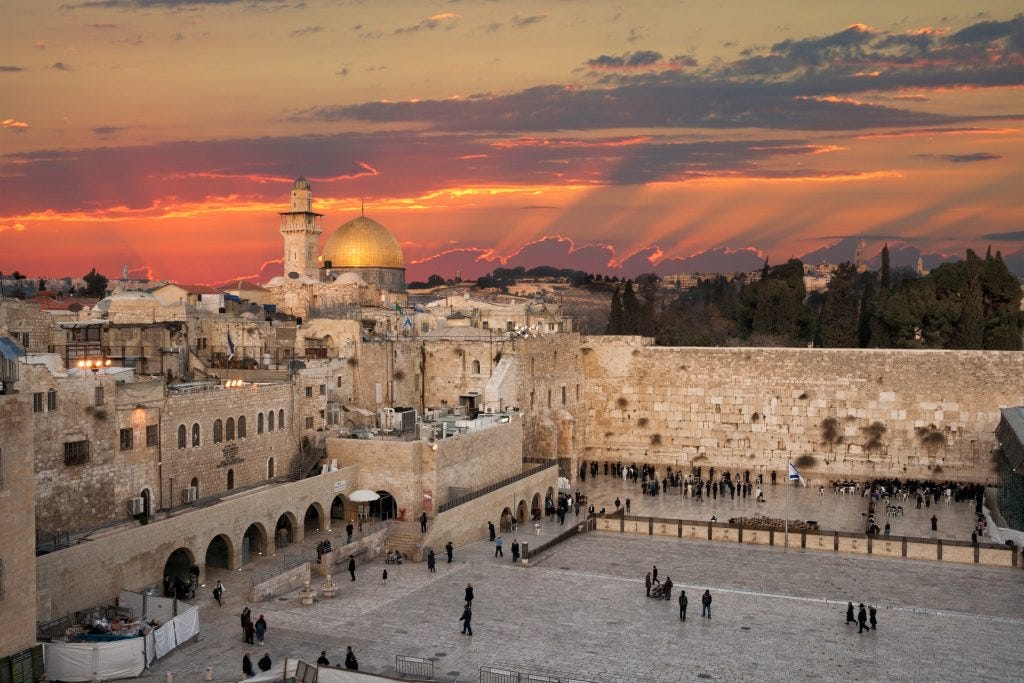
Because this affair is not a sin. It is a blessing. It does not steal love from our marriage; it fills our home with more of it. There are no secret hotel rooms, no guilty telephone calls, no hastily erased messages. My beloved waits for me openly, dressed in Jerusalem stone, glowing gold beneath the Judean sun.
Her name is Jerusalem.
And G‑d Himself introduced us.
I loved Jerusalem before I ever knew the warmth of her stones beneath my hand. I knew her through the prayers of my ancestors, through Next year in Jerusalem, through the glass broken beneath every Jewish wedding canopy, through King David’s songs and the trembling promise:
If I forget you, O Jerusalem, let my right hand forget its skill.
Other cities ask to be admired. Jerusalem demands to be remembered.
She followed the Jewish people into every exile. She slipped into our siddurim, sat beside us at our Seder tables and entered our happiest moments just long enough to remind us that something was still broken. Jews who had never seen her wept for her. Jews buried beneath foreign snow turned their faces toward her. Jews being marched toward death whispered her name.
That is not nostalgia.
That is love refusing to die.
And then I met her.
Not the imaginary Jerusalem of postcards and polished tourist brochures, but the real woman: beautiful, complicated, impatient and utterly incapable of standing quietly in line.
I fell in love with her pale stones at sunrise and the way they blush pink before evening. I fell in love with the smell of bread drifting from bakeries before dawn, with rosemary growing beside ancient walls, with the sudden scent of wet limestone when the first winter rain falls.
I fell in love with her crowded buses.
Yes, even those.
There is something wonderfully intimate about being pressed between a soldier returning to base, a grandmother hauling enough groceries to feed the entire Tribe of Judah, and a mother attempting to collapse a stroller while conducting peace negotiations with a screaming three-year-old.
Someone is reciting Tehillim. Someone is arguing with the driver. Someone is loudly explaining why the government will collapse by Tuesday. Then the bus jerks forward, an elderly passenger stumbles, and five complete strangers reach out to catch him.
Jerusalem has sharp elbows, but she also has gentle hands.
I love her crowded light rail, where the Jewish people reunite several times a day and immediately begin arguing over the available seats. Ethiopians, Moroccans, Yemenites, Russians, Americans, French Jews, secular students, Hasidim, soldiers and schoolchildren sway together as the train runs along Jaffa Road.
After two thousand years of exile, we finally came home—and naturally, nobody will move farther inside the carriage.
I love Jewish, democratic West Jerusalem: the cafés and synagogues, the Knesset and Machane Yehuda, the bookshops, protests, election posters and fierce arguments conducted over tiny cups of coffee. This is democracy with a Jerusalem accent. It does not speak softly. It interrupts, gestures wildly and calls you achi while explaining why every opinion you hold is catastrophically wrong.
It is imperfect, loud and alive.
It is Jews governing themselves in their ancient capital—not as guests begging some emperor for protection, but as citizens, voters, soldiers, judges, shopkeepers, rabbis and professional complainers.
But I do not love only West Jerusalem.
A man who truly loves a woman does not ask that she be cut in half.
I love a united Jerusalem—from the Knesset to the Kotel, from Jaffa Road to Jaffa Gate, from the Jewish Quarter to the City of David, from the Mount of Olives to the Temple Mount. I reject the idea that my beloved must once again be sliced into zones, guarded by barbed wire or divided according to the appetites of foreign governments.
Jerusalem is not a diplomatic cake to be carved at an international conference.
She is one city. One body. One soul.
For nineteen years, between 1948 and 1967, a wound ran through her. Barbed wire and concrete divided street from street. Jews were expelled from the Jewish Quarter. Ancient synagogues were destroyed. The Kotel stood only a short distance away, yet Jews could not touch its stones.
Then came the paratroopers.
I admire those young men more than words can carry. They entered through the Lions’ Gate exhausted, frightened and covered in the dust of battle. They were not figures from a legend. They were flesh and blood. Some were barely older than the children now racing through the Jewish Quarter. Some carried photographs of wives and sweethearts in their pockets. Some never returned home.
Yet they carried an entire people on their shoulders.
When Motta Gur’s voice crackled over the radio—Har HaBayit b’yadeinu. The Temple Mount is in our hands—it was not merely a military report.
It was history gasping for breath.
Then Rabbi Shlomo Goren arrived, clutching a Torah scroll and a shofar. Standing beside the paratroopers at the Kotel, he lifted the ram’s horn to his lips and blew.
The sound tore through the ancient stones.
It was Iyar, not Elul. Yet no shofar ever spoke the language of Elul more clearly.
Wake up.
Return.
Come home.
The shofar of Elul calls the soul back to G‑d. Rabbi Goren’s shofar called a nation back to Jerusalem. Perhaps those were never two separate journeys. To return to Jerusalem after centuries of exile was to rediscover something buried within the Jewish soul.
Every Elul, when I hear the first notes of the shofar, I hear an echo of Rabbi Goren’s blast hiding inside them. I see those paratroopers touching the Kotel, tough soldiers weeping without shame. I hear generations of Jews answering through them.
We are here.
We came home.
Elul is the season of love. Its name is found in the first letters of the verse:
Ani l’dodi v’dodi li.
I am my beloved’s, and my beloved is mine.
Those words describe my relationship with G‑d. They also describe the ache I feel for Jerusalem. In this city, the two loves intertwine. Jerusalem is not my god; she is where G‑d’s presence feels close enough to touch. She is the love letter He wrote to the Jewish people in stone.
Nowhere do I feel that more intensely than in the Jewish Quarter.
I walk through its narrow lanes and hear children laughing where conquerors once tried to erase every trace of Jewish life. I see the rebuilt Hurva Synagogue rising above rooftops—a building destroyed, rebuilt, destroyed again and raised once more.
That is not merely a synagogue.
That is the biography of the Jewish people.
Empires reduced it to rubble. Jews returned and built it again.
The Jewish Quarter is where history stopped being an obituary and became a home address.
And then I descend toward the Kotel.
I place my hand upon those enormous stones and feel the prayers pressed into every crack. I think of my ancestors, who would have surrendered almost anything for one moment there. I think of the paratroopers who made it possible for me to approach without asking a foreign soldier’s permission.
I kiss the stone.
But then I look upward.
Because the Kotel is not the end of my longing. It is a retaining wall.
Above it stands Har HaBayit—the Temple Mount—the holiest place in Judaism, the mountain toward which Jews have prayed throughout every exile. It is the heart of our faith, the site woven into our prayers, our mourning, our weddings and our dreams of redemption.
And something inside me screams.
I long for clear, unapologetic Jewish sovereignty on the Temple Mount.
Not because I wish to humiliate anyone. Not because another human being’s prayer threatens mine. Jewish sovereignty need not mean cruelty; it must mean courage. A Jewish democratic state can protect the sacred places of every faith without pretending that the holiest place in Judaism somehow has no Jewish owner, memory or soul.
The Mount is not vacant real estate.
It is where heaven and earth kiss in the Jewish imagination.
I long for the day when a Jew can whisper the Shema there without that prayer being treated as an act of aggression. I long for the day when Jewish sovereignty on our holiest mountain is understood not as a provocation but as the final ending of exile.
My scream is not a curse.
It is a prayer.
It is Rabbi Goren’s shofar still echoing.
It is Elul commanding us to awaken from the comfortable lie that Jews must remain strangers at the center of their own story.
Return to G‑d.
Return to Jerusalem.
Return to who you are.
My wife understands this affair. She sees what happens to my face when Jerusalem first appears in the distance. She knows why I touch her stones, why I pause when I hear the shofar and why the sight of Jewish children playing beneath the walls of the Old City can suddenly leave me unable to speak.
She does not compete with Jerusalem.
She loves me enough to understand that some loves enlarge the heart rather than divide it.
I love my wife.
I love G‑d.
And I love Jerusalem—whole, united, Jewish, democratic and sovereign.
These are not competing loves. They are threads of the same covenant: marriage, faith, peoplehood and home. Each teaches me loyalty. Each demands that I remember. Each calls me to become more than I was yesterday.
So my affair continues.
It continues through crowded buses and shofar blasts, through golden sunsets and whispered prayers. It continues in the Jewish Quarter and upon the stones of the Kotel. It continues in my longing for the Temple Mount and in my gratitude to the paratroopers who reunited a city and returned the Jewish people to the heart of their history.
Every Elul, my beloved calls again.
Ani l’dodi v’dodi li.
I am my beloved’s.
My beloved is mine.
And when Jerusalem asks whether I still love her, I answer with the word our people have carried across centuries:
Hineni.
I am here.
Your name of Greek prophetic origin into my sight came just as I was
reading this...'Greece approved the acquisition of an Israeli multilayered air defense system worth up to roughly $4.1 billion, which will form the backbone of its “Achilles Shield” and integrate Israeli radar and missile systems designed to counter ballistic missiles, aircraft, and drones.' -put up on JNS... , comfort in the confirmation beyond time snd dpace... there are no coincidence. The alliance is brilliantly given and thank you and those who named and so blessed you with prophecy. G-D bless you in all ways alway. ✍🏻RL
très beautiful🌤️