


I used to think Tu B’Av was Judaism’s answer to Valentine’s Day.
I could not have been more wrong.
The older I become, the more I realize that Tu B’Av is not about finding someone to love.
It is about remembering what love actually is.
That realization came to me not in a synagogue, but while wandering through the Jerusalem Botanical Gardens.
The world teaches us to admire flowers.
Judaism teaches us to ask why they bloom.
I found myself standing beneath the shade of ancient trees, watching children laugh, couples stroll hand in hand, butterflies drift lazily from flower to flower, and the Jerusalem breeze carry the fragrance of jasmine and rosemary through the gardens.
Nothing dramatic happened.
No voice emerged from Heaven.
No revelation interrupted the afternoon.
Yet I walked away convinced that beauty itself is one of God’s languages.
Perhaps that is why the Torah never begins with commandments.
It begins with a garden.
Before there was a nation…
Before there was Sinai…
Before there was Jerusalem…
There was a garden where man learned that love, responsibility, and the presence of God were never meant to be separated.
The Torah never treats beauty as an accident.
The Midrash teaches that when the Holy One created the world, He looked upon it and declared that it was good. Not useful. Not efficient.
Good.
Beautiful.
The beauty of creation is not decoration.
It is revelation.
That is why the Land of Israel has always felt different.
The Torah describes it as “a land upon which the eyes of the Lord your God are continually fixed, from the beginning of the year until the end of the year.”
No other land receives such a description.
Not because its mountains are taller.
Not because its rivers are greater.
But because this is the place where covenant became geography.
Where faith took root in soil.
Where heaven and earth seem just a little closer together.
Rabbi Abraham Isaac HaKohen Kook saw the return to the Land of Israel as far more than a political event. He believed that when the Jewish people returned home, the land itself would awaken. The blossoming fields, the vineyards climbing once-barren hillsides, the forests planted across ancient landscapes were not merely agriculture. They were the visible heartbeat of redemption.
When you stand among the flowers of Jerusalem, it is difficult not to understand what he meant.
The land does not merely sustain Jewish life.
It participates in it.
The Mishnah tells us that there were no happier days for Israel than Yom Kippur and Tu B’Av.
That pairing has fascinated generations of commentators.
Yom Kippur is the day when God says to His people, “I forgive you.”
Tu B’Av is the day when His people answer, “We still love You.”
One repairs the covenant.
The other celebrates it.
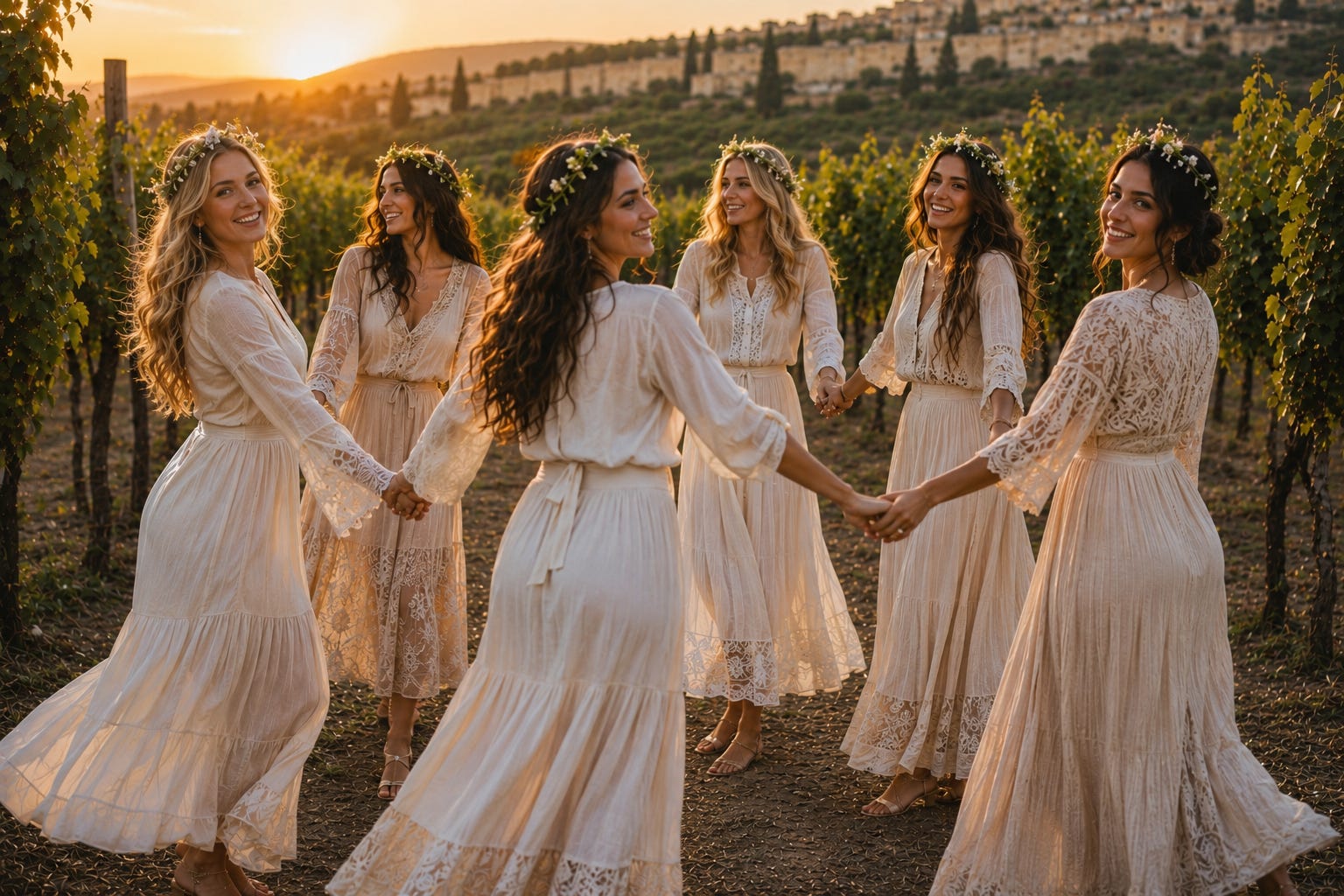
The daughters of Jerusalem clothed themselves in borrowed white garments so that wealth would disappear and dignity would remain. They danced among the vineyards, calling upon the young men not to choose beauty alone but to seek character, faith, and virtue.
How extraordinary.
Even Judaism’s most romantic day begins with humility.
Rabbi Moshe Feinstein often wrote that the strength of a Jewish home is not measured by excitement but by faithfulness. A marriage is built through thousands of ordinary acts of kindness, patience, sacrifice, and respect. Romance begins a marriage. Commitment sanctifies it.
The Lubavitcher Rebbe expressed a similar truth from another direction. Love is not something we wait to feel. Love grows through giving. Every genuine act of generosity enlarges the soul that gives it. We imagine that we give because we love. More often, we discover that we love because we have given ourselves away.
Suddenly Tu B’Av begins to look very different.
It is not a celebration of emotion.
It is a celebration of covenant.
Rebbe Nachman of Breslov taught that every blade of grass has its own song, and that if we become still enough, we may begin to hear the music of creation itself.
Standing in Jerusalem, I think I understand him.
Not because I literally hear grass singing.
But because there are moments when creation seems transparent, when the beauty before your eyes points beyond itself toward the One who fashioned it.
Perhaps that is why King David could look at the heavens and compose songs.
Perhaps that is why the prophets found God in vineyards, mountains, shepherds, fig trees, olive groves, and desert winds.
The world had not become less ordinary.
Their eyes had become more attentive.
Rabbi Jonathan Sacks often reminded us that Judaism transformed the history of civilization by teaching that love is not merely an emotion but a responsibility. God loves humanity not because humanity is perfect but because He chooses to remain faithful to His covenant. Likewise, the Jewish home, the Jewish community, and the Jewish nation endure because love is sustained by commitment.
That insight explains something extraordinary about Jewish history.
For nearly two thousand years, Jews prayed facing Jerusalem.
They married beneath a chuppah while breaking a glass for Jerusalem.
They concluded every Passover Seder with the words, “Next year in Jerusalem.”
Most had never seen the city.
Many never would.
Yet they loved it.
Not because they possessed it.
Because they belonged to it.
Rabbi Shlomo Riskin has often spoken about Zionism as the renewal of an ancient relationship. The return to Israel is not simply the establishment of a state. It is the restoration of a family to its ancestral home. It is the reunion of a people with the landscape that shaped its language, its prophets, its festivals, its prayers, and its dreams.
Perhaps that is the secret of Tu B’Av.
It follows Tisha B’Av.
The Jewish calendar refuses to leave us in despair.
First we mourn the destruction of Jerusalem.
Then we celebrate love.
First we remember what hatred destroys.
Then we remember what love rebuilds.
Only the Jewish people could place those two days beside one another.
Only the Torah could teach that the deepest love is not the love that has never suffered.
It is the love that remained faithful after suffering.
When I walk through the Botanical Gardens in Jerusalem now, I no longer see flowers alone.
I see Abraham looking toward Mount Moriah.
I see Ruth gathering grain in the fields of Bethlehem.
I see David composing psalms beneath the Judean sky.
I see generations of Jews in Warsaw, Baghdad, Fez, Vilna, Cape Town, New York, and Buenos Aires whispering the same prayer through tears:
“Next year in Jerusalem.”
And then I remember something almost too beautiful for words.
I do not have to whisper it anymore.
I can simply open my front door.
Perhaps that is the greatest miracle of Tu B’Av.
Not that we found the Land of Israel.
But that after centuries of longing, the love story between God, the Jewish people, and this tiny strip of holy earth is no longer only remembered.
By the grace of God…
It is being lived.
You write shear poetry Yonah. I’m sorry I missed seeing the gardens, but I’ve always felt that nature is G-d’s gift to us!
I’m going to cry, this was so beautiful and heartwarming- thank you Yonah for sharing this wonderful story with us and God bless you and your family and all the people in Israel❣️🙏❤️💕💖😻