


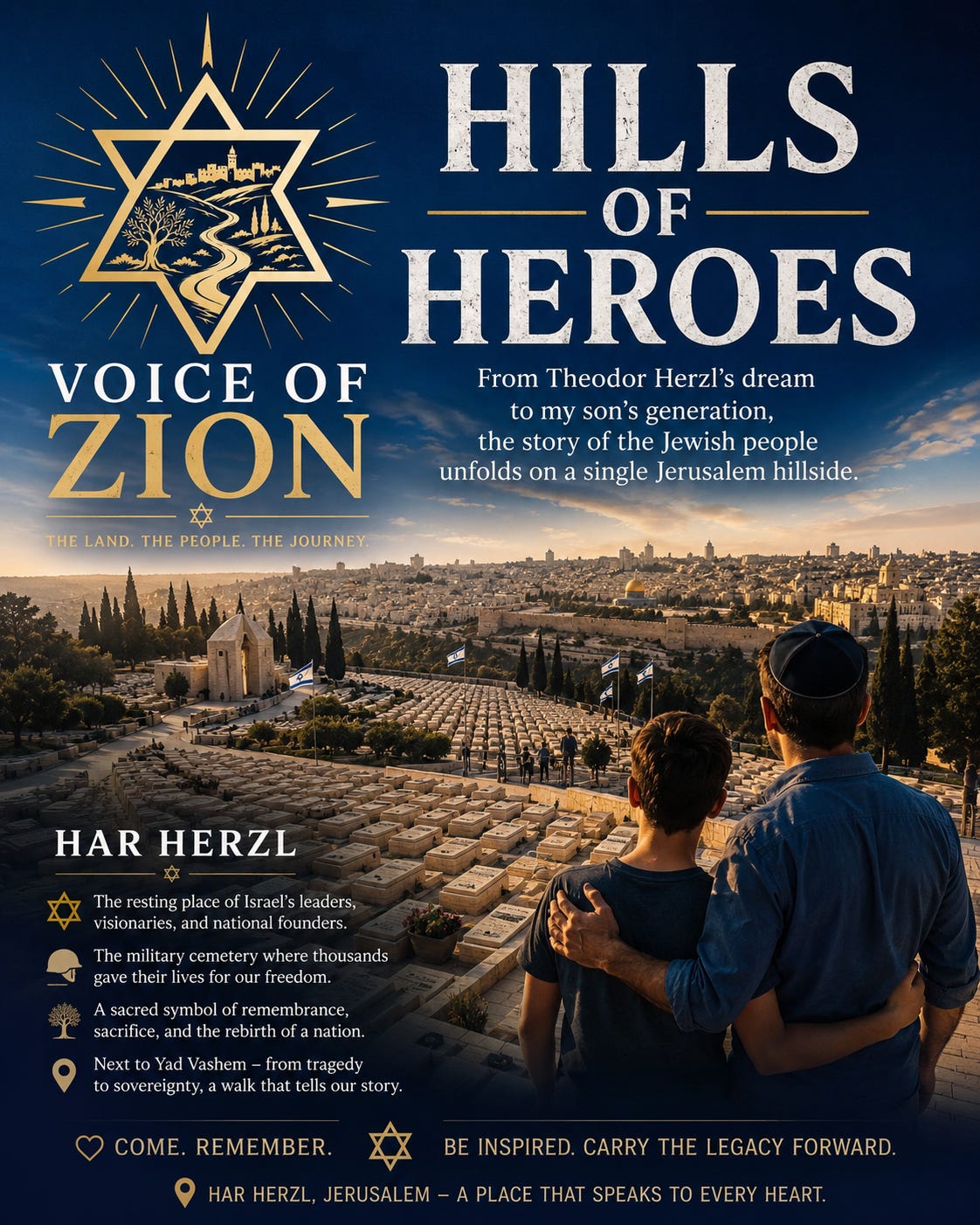
I stood on Har Herzl many years before I ever called Israel home.
Every visit has been different.
Every visit has left me quieter than when I arrived.
And every year, almost without thinking about it, I find myself returning.
Some people have favorite beaches. Others return to mountain cabins or family vacation spots. I return to a hill in Jerusalem where thousands of white stones rise from the earth like silent witnesses to one of the greatest stories ever told.
It is not because I enjoy cemeteries.
It is because Har Herzl is not really about death.
It is about why a people chose life.
This visit, however, carried a different weight.
I wasn’t making another pilgrimage simply to remember. I was there to celebrate my fifteen-year-old son.
That sentence would sound almost contradictory anywhere else in the world.
Who celebrates at a cemetery?
Israel does.
Not because Israelis are indifferent to death.
Because Israelis understand something ancient that much of the modern world has forgotten.
Memory and hope belong together.
One cannot survive without the other.
My son had completed the first stage of an extraordinary leadership program. It is not the kind of program most people outside Israel would recognize. There are no hotel conference rooms, no motivational speakers pacing across brightly lit stages, no certificates celebrating leadership as though it were simply another skill to add to a résumé.
Instead, these teenagers spend months walking.
They hike across deserts and forests, through ancient cities and forgotten valleys, over Roman roads and biblical trails. They study geography, archaeology, military history, ecology, navigation, Jewish history, and the stories hidden beneath the rocks beneath their feet. They learn how to become guides, not merely because Israel welcomes tourists, but because every nation depends upon people capable of telling its story honestly.
Leadership here begins with knowing the land.
Not owning it.
Knowing it.
Knowing why a vineyard grows where it does.
Knowing why a fortress stands on one hill while another remained empty.
Knowing why one valley witnessed a biblical battle while another became the birthplace of modern agriculture.
Knowing why millions of people have prayed toward Jerusalem for nearly two thousand years.
In Israel, maps are never just maps.
Every contour line is another chapter of history.
As families gathered that afternoon beneath Jerusalem’s brilliant summer sky, there was laughter everywhere.
Parents adjusted collars before taking photographs.
Grandparents embraced grandchildren.
Teenagers, suddenly aware they were becoming young adults, stood a little straighter than usual.
Children chased one another across the grass with the carefree confidence only children possess.
It looked like any family celebration.
Then you looked beyond the gathering.
Row after row after row of white military headstones stretched across the hillside.
The contrast was breathtaking.
Joy stood beside sacrifice.
Life stood beside memory.
Neither diminished the other.
They completed each other.
I have often wondered whether someone visiting Israel for the first time could ever fully understand that scene.
Perhaps not immediately.
But they would feel it.
Because Har Herzl possesses something almost impossible to describe.
Silence.
Not the silence of emptiness.
The silence of significance.
The kind of silence found inside great cathedrals, ancient forests, or beneath the stars in the Judean Desert.
It asks nothing from you except attention.
To understand Har Herzl, you have to understand a man who never lived to see it.
His name was Theodor Herzl.
Today his face appears in history books, museums, and classrooms around the world. Streets bear his name. Schools bear his name. Parks bear his name.
When he was alive, however, he was considered by many to be unrealistic.
Some thought he was naïve.
Others thought he was dangerous.
Still others thought he was simply dreaming.
Herzl was born in Budapest in 1860 and later built a successful career as a journalist in Vienna. Like countless educated European Jews of his generation, he believed that the future belonged to integration. If Jews became loyal citizens of the countries where they lived, surely antisemitism would eventually fade into history.
History had other plans.
In 1894 a Jewish officer in the French Army named Alfred Dreyfus was falsely accused of treason. As Herzl reported on the trial in Paris, he watched crowds fill the streets screaming, “Death to the Jews.”
Not death to Dreyfus.
Death to the Jews.
France was supposed to be the enlightened nation of liberty, equality, and fraternity.
If hatred could erupt there, Herzl concluded, nowhere in Europe was truly safe.
He returned to Vienna transformed.
Within two years he published The Jewish State, arguing that the Jewish people did not merely need sympathy from the nations of the world.
They needed a home.
A state.
A place where Jewish history would once again be written by Jews.
The idea sounded impossible.
For nearly two thousand years Jews had lived scattered across continents.
Empires had risen and fallen.
Kingdoms had vanished.
Languages had disappeared.
Yet somehow the Jewish people remained.
Still praying.
Still remembering.
Still ending every Passover meal with the same astonishing words:
“Next year in Jerusalem.”
Most people treated those words as poetry.
Herzl treated them as a blueprint.
In 1897 he convened the First Zionist Congress in Basel, Switzerland.
More than two hundred delegates attended.
When the congress ended, Herzl wrote in his diary words that remain among the most prophetic in modern history.
“In Basel I founded the Jewish State.”
He immediately added that if he said such a thing publicly everyone would laugh at him.
“Perhaps in five years, certainly in fifty, everyone will know it.”
Fifty years later, almost to the month, the United Nations voted to establish a Jewish state.
History sometimes moves slowly.
Then suddenly.
Herzl died in 1904.
He was only forty-four years old.
He never saw the State of Israel.
He never heard Hebrew spoken in the streets of Jerusalem.
He never watched airplanes land at Ben-Gurion Airport.
He never saw children running through Jewish neighborhoods built where barren hills once stood.
But before he died, he made one request.
Do not bury me permanently in Europe.
When the Jewish people return home, bring me with them.
In August 1949, one year after Israel declared independence, hundreds of thousands of Israelis lined the streets of Jerusalem as Herzl’s remains were carried to the summit of a hill overlooking the capital.
The founder had finally come home.
The mountain became Har Herzl.
His grave remains astonishingly simple.
Black granite.
One name.
No towering monument.
No elaborate sculpture.
Perhaps because the true monument was never intended to be stone.
It was the country surrounding it.
From Herzl’s grave the paths lead toward the graves of those who transformed vision into reality.
Prime ministers.
Presidents.
Commanders.
Statesmen.
Golda Meir rests there.
A grandmother with steel in her spine who led Israel through the trauma of the Yom Kippur War.
Levi Eshkol.
Yitzhak Rabin.
Yitzhak Shamir.
Shimon Peres.
Each represents a different chapter in Israel’s story.
Each carried impossible burdens.
Each made decisions whose consequences reached millions.
History often reduces leaders to political debates.
Standing before their graves reminds you that they were human beings asked to make impossible choices in impossible times.
Yet even these famous names eventually disappear from your attention.
The mountain gently pulls your eyes elsewhere.
Toward the military cemetery.
Thousands upon thousands of identical white stones.
No marble mausoleums.
No towering statues.
No hierarchy of grief.
A general rests beside a private.
A pilot beside a medic.
A young woman beside a young man.
The stone does not tell you whether they were wealthy or poor.
Religious or secular.
Born in Tel Aviv, Addis Ababa, Moscow, Paris, Buenos Aires, or New York.
It tells you only what ultimately mattered.
They gave their lives defending the Jewish people.
You begin reading the dates.
Nineteen.
Twenty.
Twenty-one.
Twenty-three.
Lives interrupted almost before they began.
Every stone represents parents whose world changed forever.
Friends who still hear familiar voices.
Brothers and sisters who still set an extra place in their memories.
Children who know their father only through photographs.
Somewhere beneath each stone lies an entire universe.
There is a story told about Rabbi Shlomo Zalman Auerbach, one of the greatest Torah scholars of the twentieth century.
A student once asked whether he should travel north to pray at the graves of righteous sages.
The rabbi replied that if he wished to pray at the graves of truly righteous people, he should go to Har Herzl.
I understood that teaching differently as I stood there.
He was not comparing one kind of holiness against another.
He was reminding us that holiness is also found in sacrifice.
In young men and women who never sought greatness, yet became part of something infinitely greater than themselves.
Just beyond Har Herzl stands Yad Vashem, Israel’s Holocaust memorial.
The distance between them is measured in minutes.
The meaning of that distance cannot be measured at all.
On one hill the Jewish people remember six million murdered because they had no state to defend them.
On the other they remember those who died ensuring that such helplessness would never define Jewish history again.
That geography is not accidental.
It is theology written in stone.
It is history arranged as landscape.
Walk from Yad Vashem to Har Herzl and you walk from catastrophe to renewal.
From exile to return.
From powerlessness to sovereignty.
From ashes to independence.
Few countries tell their national story through geography.
Israel does.
As the ceremony for my son concluded, I watched him laughing with friends.
Fifteen years old.
Standing on the mountain where Herzl’s dream, Israel’s leadership, and Israel’s sacrifice meet.
It struck me that his education is profoundly different from my own.
He is not merely learning about Israel.
He is growing up inside it.
Its mountains are becoming his classroom.
Its history is becoming his inheritance.
Its future, one day, will become his responsibility.
I looked around at the families celebrating.
Then I looked back toward the endless rows of white stones.
For a moment the entire story of Israel seemed compressed into a single afternoon.
A visionary who imagined the impossible.
Leaders who built a nation.
Young men and women who defended it.
Teenagers preparing to lead the next chapter.
Four generations sharing one mountain.
I left Har Herzl the way I always do.
More grateful than when I arrived.
Grateful that I no longer have to imagine what it means when Jews speak of coming home.
Grateful that my children are growing up where Jewish history is not a chapter in a textbook but the landscape outside their window.
Grateful that my son is learning that leadership begins not with power, but with humility. Not with ambition, but with memory. Not with standing above others, but with carrying forward what others entrusted to you.
Har Herzl is often described as Israel’s national cemetery.
It is.
But that description barely scratches the surface.
It is where an impossible dream found its resting place.
Where a scattered people became a nation again.
Where remembrance protects freedom.
Where the past refuses to be forgotten because it continues to shape the future.
It is one of the holiest places on earth, not because miracles once happened there, but because ordinary men and women proved that faith, courage, sacrifice, and hope can change the course of history.
Every time I leave that mountain, I carry the same thought with me.
The story of the Jewish people did not end in exile.
It climbed this hill, buried its dead with honor, celebrated its children with joy, and kept walking toward tomorrow.
Your writing is magnificent
So Beautiful.