


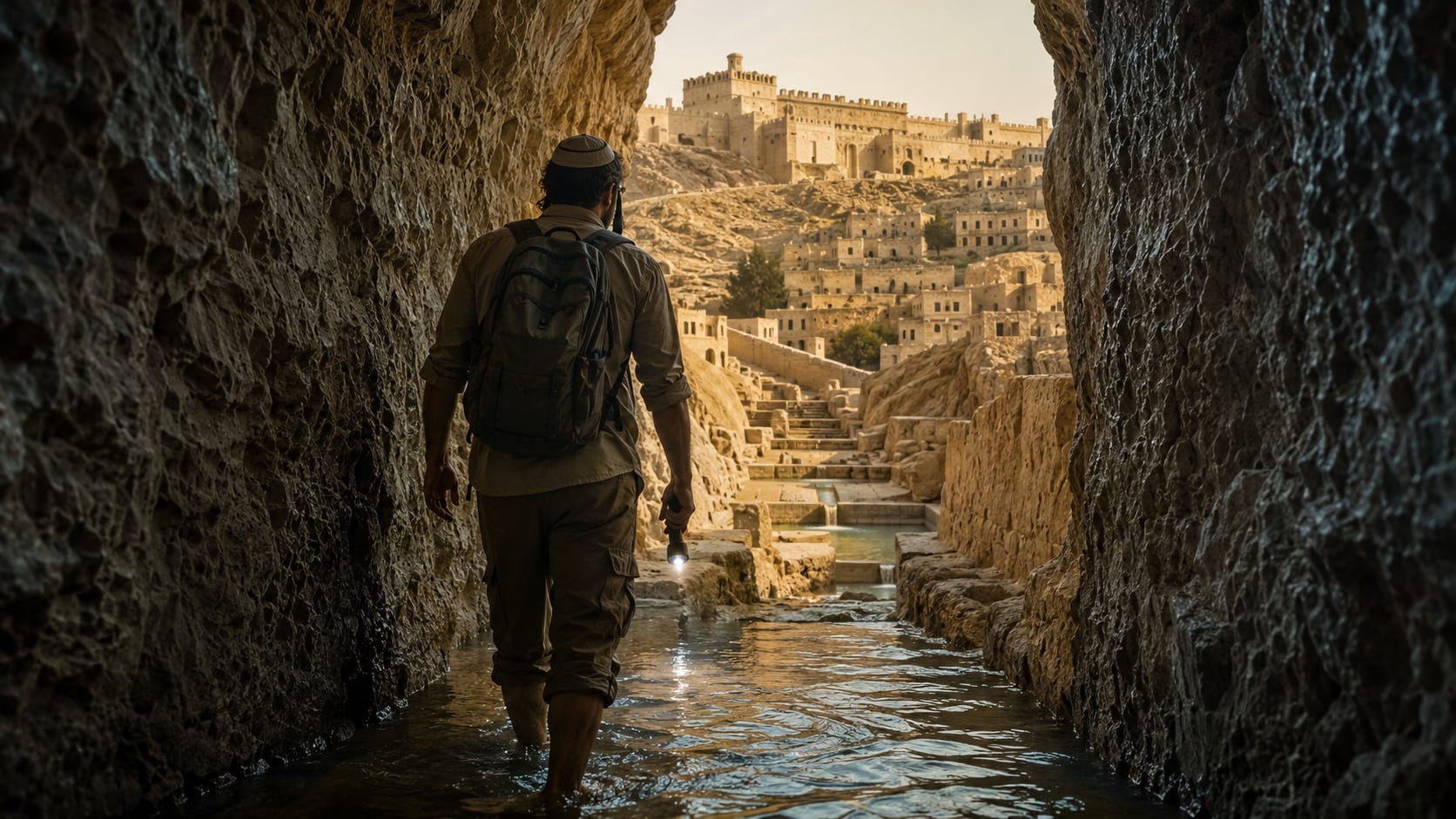
I walked through the City of David today—the ridge where Jerusalem became Israel’s capital, Jewish engineers carved survival into bedrock, and 3,000 years of history refused to behave like a political slogan.
Today I walked into the City of David and watched a modern political slogan lose a fistfight with 3,000 years of stone.
The entrance sits just downhill from the Old City, only a few minutes from the Western Wall. Yet the first surprise is that ancient Jerusalem did not begin inside the walls tourists photograph today. Those walls are Ottoman, built under Sultan Suleiman the Magnificent in the sixteenth century. Biblical Jerusalem began farther south, on a narrow limestone ridge squeezed between the Kidron Valley on the east and the ancient Tyropoeon Valley on the west, with the Gihon Spring bursting from its lower eastern slope.
That ridge is the City of David. Not a symbolic name invented for a visitor center. Not a neighborhood given a biblical nickname by an enthusiastic tour guide. It is the southeastern hill identified by the overwhelming weight of archaeology and topography as Jerusalem’s earliest urban core—the place the Hebrew Bible calls Ir David.
Jerusalem keeps her birth certificate underground. To read it, you descend staircases, pass walls built before Rome existed, squeeze through rock-cut passages and follow water engineered by Jewish hands twenty-seven centuries ago. It is history you feel in your knees.
Before Jerusalem, David Faced a Giant
The story of King David did not begin here. It began in Bethlehem, where the prophet Samuel anointed the youngest son of Jesse—the ruddy young shepherd nobody had bothered to call in from the fields.
Then came the Valley of Elah.
Across that valley stood the Philistine army and its champion, Goliath of Gath, a heavily armed warrior who spent forty days humiliating Israel and daring anyone to fight him. David arrived carrying food for his brothers, heard the taunts and reacted with the righteous disbelief of a teenager who had not yet learned that adults can become very sophisticated at explaining why cowardice is practical.
He refused Saul’s armor because he could not move in it. He took his staff, his sling and five smooth stones from the streambed. Then he told Goliath exactly what was about to happen:
“You come against me with sword, spear and javelin, but I come against you in the name of the Lord of Hosts, the God of the armies of Israel, whom you have defied.”
In Hebrew, the heart of that declaration is unforgettable: אָנֹכִי בָא־אֵלֶיךָ בְּשֵׁם ה׳ צְבָאוֹת—“I come to you in the name of the Lord of Hosts.”
David’s sling was not a child’s toy. In trained hands it was a battlefield weapon. The stone struck Goliath in the forehead, the giant crashed face-first into the earth, and David finished the fight with Goliath’s own sword. The Philistine army ran. Israel discovered that its future king was not impressed by size, armor, noise or expert predictions of inevitable defeat—a rather useful Jewish leadership trait, as history would repeatedly demonstrate.
Goliath fell in the Valley of Elah, not in Jerusalem. That distinction matters. The City of David tells the next stage of the story: how the shepherd who defeated a giant became the king who gave Israel its eternal capital.
Why David Chose Jerusalem
After years of being hunted by Saul and after Saul’s death, David ruled from Hebron for seven years and six months. Eventually the tribes came to him and anointed him king over all Israel. He now needed a capital that could unite a fractured nation.
Hebron was deeply associated with Judah. Choosing a northern tribal center would have created the opposite problem. Jerusalem, then a Jebusite stronghold, sat near the boundary between Judah and Benjamin and belonged to no Israelite tribe as an established capital. It was centrally placed, naturally defended and politically brilliant.
It was also extremely difficult to capture.
The Jebusites were so confident in their fortress that, according to the Book of Samuel, they mocked David that even the blind and lame could keep him out. David captured the “fortress of Zion” anyway and renamed it the City of David. The biblical text mentions a tzinnor, a word connected with a shaft, conduit or water passage, although the exact route and method of entry remain debated. For years visitors were told that David’s soldiers climbed through the vertical passage now called Warren’s Shaft. Later excavations showed that explanation is far from certain. Honest archaeology does not need to turn every theory into dogma. The conquest is part of the ancient account; the precise underground maneuver remains an open question.
David established his residence here, fortified the city and built outward from the Millo. He brought the Ark of the Covenant to Jerusalem, transforming the city into more than a seat of government. It became the political and spiritual heart of Israel.
That choice changed world history. Jerusalem would enter Jewish prayer, prophecy, mourning, marriage ceremonies and daily memory. Jews would face it in prayer. We would invoke it at funerals and under wedding canopies. We would end Passover Seders with Next year in Jerusalem while empires rose, renamed streets, rewrote maps and disappeared.
The empires are exhibits now. Jerusalem is still Jerusalem.
Solomon at the Gihon
The Gihon Spring was not merely Jerusalem’s water supply. It was a stage on which Jewish kingship itself was secured.
Near the end of David’s life, his son Adonijah attempted to seize the throne. David responded by ordering that Solomon be placed on the king’s own mule and taken down to the Gihon. There, beside the spring, Zadok the priest and Nathan the prophet anointed Solomon. A shofar sounded and the people cried, “Long live King Solomon!” The celebration was so loud that the earth seemed to split with the noise.
Stand near the Gihon today and let that sink in. This is not a vague tradition attached to an unspecified Jerusalem hillside. The biblical narrative names the spring. The spring still flows. The geography still makes sense.
Solomon expanded the royal and sacred center northward toward the Ophel and the Temple Mount. According to the Book of Kings, he began building the Temple in the fourth year of his reign and completed it seven years later, using dressed stone and cedar supplied through his alliance with Hiram of Tyre. The Ark was brought into the Holy of Holies, and Jerusalem became the center of national worship.
David conquered the capital, purchased the threshing floor associated with the future Temple site and prepared the way. Solomon built. Between father and son, Jerusalem became the city that would define Jewish civilization.
Jerusalem Exists Because Water Exists
Ancient cities did not survive on panoramic views and good intentions. They survived on water.
The Gihon is the reason settlement took root on this ridge. For much of its known history it behaved as a rhythmic or intermittent spring, surging and weakening in cycles. It was Jerusalem’s essential natural water source, but it emerged low on the eastern slope—an awkward and dangerous position whenever an enemy surrounded the city.
Long before David, Canaanite builders understood the problem. Around the eighteenth century BCE, they enclosed and defended the spring with an enormous fortification now called the Spring Citadel. Massive stones protected the source and controlled access from inside the city. They cut passages, channels and pools to collect water and carry it toward fields in the Kidron Valley.
The scale matters. David did not conquer an empty hill with three tents and a goat. He captured a formidable Canaanite-Jebusite city with sophisticated defenses and water engineering. Admitting that earlier history does not weaken the Jewish story; it makes David’s achievement intelligible. Every serious nation has predecessors. If an earlier civilization automatically canceled all later national rights, most of the world would need to pack immediately.
In 1867, British engineer Charles Warren crawled through the Gihon’s underground passages and discovered the near-vertical natural shaft that now bears his name. For decades scholars thought Jerusalem’s residents lowered buckets through it and that David’s men may have used it to enter the city. Excavations by Ronny Reich and Eli Shukron transformed that picture. The protected Canaanite approach to the spring was far more elaborate, and the shaft itself was probably not the bucket-drawing system Warren imagined.
That is what makes this site magnificent. It is not frozen. Every excavation sharpens the picture. The stones do not change, but our ability to question them does.
Hezekiah’s Answer to Assyria
Roughly three centuries after David, Jerusalem faced an enemy that had already pulverized much of the region.
The Assyrian Empire destroyed the northern Kingdom of Israel in the late eighth century BCE. In 701 BCE, King Sennacherib invaded Judah and captured Lachish, the kingdom’s second great city. Jerusalem was next. Hezekiah understood the brutal arithmetic of siege warfare: walls without water are delayed coffins.
So Jerusalem turned geology into national defense.
The popular shorthand says Hezekiah’s Tunnel was built “during the siege.” More precisely, it was a siege-preparation project undertaken under the Assyrian threat. Hezekiah’s workers blocked or concealed access to the Gihon outside the defenses and redirected its water through the ridge toward the western side of the City of David, where it collected in the Pool of Siloam.
The tunnel runs about 533 meters through solid limestone. It twists in a great S-shaped path, yet the difference in elevation from beginning to end is only about thirty centimeters. Thirty centimeters across more than half a kilometer—without laser levels, satellite mapping or a civil engineer sending a passive-aggressive email about the revised deadline.
Two teams carved toward one another from opposite ends with picks and chisels. The mystery of how they coordinated their route underground is still debated. They may have followed natural cracks, surface markings, sound signals or a combination of methods. What is not debated is that they met.
We know because the workers left us their own account.
The Siloam Inscription, discovered in 1880 near the tunnel’s southern exit, was cut in ancient Hebrew script. Its surviving six lines describe the final breakthrough: workers heard one another’s voices through the rock, struck “pick against pick,” and watched the water flow from the spring to the pool for 1,200 cubits. It does not name Hezekiah, but its script belongs to the late eighth century BCE, scientific dating supports construction around that period, and its engineering matches the biblical descriptions of Hezekiah making a pool and conduit and directing the Gihon westward into the City of David.
The original inscription was removed during Ottoman rule and remains in Istanbul. Jerusalem has the tunnel; Turkey has the Hebrew label that explains it. History occasionally develops a very dark sense of humor.
Walking through the tunnel is unlike looking at an artifact behind glass. The water is cold around your legs. The passage narrows. Chisel marks run along the walls. Switch off the light and the darkness is absolute. Then remember that men entered that black rock from opposite directions while the most terrifying military empire of their age approached Judah.
This was not merely plumbing. It was Jewish survival carved into bedrock.
The Pools That Fed a Capital
The Pool of Siloam developed over centuries rather than appearing in a single building campaign.
A monumental dam associated with the pool’s water system has now been scientifically dated to approximately 805–795 BCE, during the reigns of Kings Joash or Amaziah—earlier than Hezekiah. The exposed structure rises about twelve meters, is more than eight meters wide and extends at least twenty-one meters. It is the largest dam yet discovered in ancient Israel and the earliest known in Jerusalem. It captured water from the Gihon system as well as violent floodwater rushing through the city’s central valley. Ancient Jerusalem was already conducting large-scale water management before the Assyrian crisis forced Hezekiah’s famous tunnel project.
Hezekiah’s system later brought Gihon water to the Siloam area inside the defended city. Centuries afterward, near the end of the Second Temple period, the pool was rebuilt and dramatically enlarged. At its height it covered roughly five dunams and was lined with broad stone steps that allowed people to descend as the water level changed.
For Jewish pilgrims arriving for Passover, Shavuot or Sukkot, the pool likely served both practical and ritual purposes. From there, crowds ascended toward the Temple along the monumental stepped street now known as the Pilgrimage Road. Coins, paving stones, shops, drainage channels and the road itself reconstruct a living Jewish capital—not a sepia biblical illustration, but a city of merchants, priests, children, arguments, sacrifices, dust and enormous festival crowds.
The road leads north toward the Temple Mount. The direction is not politically convenient. Stone tends to be inconsiderate that way.
What the Excavations Have Actually Found
The City of David has been excavated by generations of archaeologists: Charles Warren in the nineteenth century; Kathleen Kenyon in the 1960s; Yigal Shiloh from 1978 to 1985; Eilat Mazar; Ronny Reich and Eli Shukron; and teams from the Israel Antiquities Authority, Tel Aviv University and other institutions working today.
The dating is becoming sharper as the science improves. A major 2024 study published in Proceedings of the National Academy of Sciences analyzed 103 radiocarbon dates from five excavation areas. The samples came from secure archaeological contexts and included short-lived organic material that could be tied to specific building phases. The results found settlement on the ridge during the twelfth through tenth centuries BCE—the broad era in which the biblical account places David—and extensive architectural activity across Jerusalem by the ninth century BCE. It does not stamp David’s name on every wall. It does make the old caricature of an empty, irrelevant hill increasingly difficult to sustain.
Near the top of the ridge stands the immense Stepped Stone Structure, a terraced mass supporting the slope below the ancient acropolis. It may be connected with the biblical Millo, a royal fortress or another monumental construction. Above it, Eilat Mazar uncovered what she called the Large Stone Structure and proposed that it formed part of David’s palace. Other archaeologists dispute the identification and aspects of the dating. The fair description is thrilling enough: a monumental public complex stood in the upper City of David around the formative centuries of the kingdom, while the claim that it is David’s palace remains a serious but contested interpretation.
That distinction is important. The City of David does not need fake certainty. A site containing genuine ancient Hebrew inscriptions, royal administration, fortifications, houses, destruction layers and waterworks gains nothing from pretending every disputed wall arrived with a brass plaque saying DAVID SLEPT HERE.
Farther down the slope, excavations uncovered the administrative quarter of the Kingdom of Judah. Archaeologists found houses, storage vessels, arrowheads, a burned room and a remarkable group of fifty-one clay seal impressions known as bullae. These were once attached to rolled documents. The papyrus burned away, but the fire hardened the clay and preserved the names.
One bulla bears the name Gemaryahu son of Shaphan—the same name and patronymic carried by a royal scribe in the Book of Jeremiah. Other seal impressions bear names associated with officials mentioned in Jeremiah’s account of the final decades before Jerusalem’s destruction. A name match is not magical proof of every biographical detail, but it places Judahite officials, Hebrew writing and a functioning royal bureaucracy exactly where the historical setting says they belonged.
The destruction itself is visible. Babylonian forces burned Jerusalem in 586 BCE, destroyed the First Temple and carried much of the population into exile. Excavators have found collapsed buildings, charred pottery, arrowheads and ash from that catastrophe. In 2026, archaeologists announced the discovery of unusually well-preserved wooden roof beams burned in the Babylonian destruction. Melted wall plaster apparently sealed the timbers and protected them for roughly 2,600 years.
That is the City of David: the rise of Jerusalem, its water, its government, its worship, its destruction and its return, stacked in layers beneath a living city.
Now Let Us Discuss “East Jerusalem”
The phrase “East Jerusalem” is repeated today as if it describes an ancient foreign capital that Jews wandered into after taking a wrong turn in 1967.
Then you visit the City of David.
Here, in the part of Jerusalem placed east of the 1949 armistice line, David established Israel’s capital. Solomon was anointed at the Gihon. Judahite engineers redirected the spring. Hebrew workers recorded their tunnel in Hebrew. Royal officials sealed documents with Hebrew names. Jewish pilgrims climbed from the Pool of Siloam toward the Temple.
The modern compass label cannot retroactively deport them.
Does archaeology function as a deed to every privately owned house in modern Jerusalem? Of course not. That would be a ridiculous standard, and no country on earth could satisfy it. Individual property rights remain individual property rights. Archaeology establishes something larger and politically devastating to the fashionable lie: the Jewish people are not foreign settlers in Jerusalem. We are an indigenous nation returning to, rebuilding and governing the capital in which our national life was formed.
The Green Line through Jerusalem was not an ancient border. It was the military armistice line left after the 1948 war, and the Israel-Jordan agreement explicitly stated that the line did not prejudice future borders or territorial claims. Jordan controlled the eastern part of the city for nineteen years, expelled the Jews of the Old City’s Jewish Quarter and denied Jews access to our holiest places. That brief occupation is constantly treated as sacred legal antiquity while three millennia of Jewish connection are dismissed as mythology. It is an argument so upside down it should be charged rent for hanging from the ceiling.
Israel has the historical and moral right to exercise sovereignty over a united Jerusalem—west, east, north and south—and the responsibility to protect the civil and religious rights of every resident. Those principles do not contradict each other. Jewish sovereignty is not a demand to erase anyone else. It is a refusal to permit anyone else to erase us.
Archaeology alone does not create that right. Jewish memory, continuous attachment, national self-determination, lawful governance and the defense of the city all belong to the argument. Archaeology does something simpler: it destroys the claim that Jewish Jerusalem was invented yesterday.
If your theory of Jerusalem requires David, Solomon, Hezekiah, Jeremiah, the Gihon, the Siloam Inscription, the bullae and the Pilgrimage Road all to shut up, your theory is not history. It is propaganda wearing an academic scarf.
Go and Walk It
Do not experience the City of David through a thirty-second video filmed by a man who calls every old wall “incredible” and then sprints back to his tour bus. Go.
Take the guided biblical tour. Stand above the ridge and understand the valleys. Descend to the Gihon. Study the Canaanite defenses. Walk the dry ancient channel if you prefer, or put on water shoes and enter Hezekiah’s Tunnel with a light. Continue to the Pool of Siloam. If time allows, walk the Pilgrimage Road toward the Temple Mount and follow the route taken by Jewish worshippers two thousand years ago.
Bring your children. Bring Christians who want to understand the world of the Bible. Bring secular Jews who think Tanakh is merely a book they survived in school. Bring skeptics. Especially bring skeptics. Jerusalem is not frightened by questions.
The City of David is not a side attraction beneath the “real” Jerusalem. It is the opening chapter. It is where a shepherd’s courage became a kingdom, where a spring became a capital, where engineers answered an empire and where the stones keep returning Jewish history to the surface no matter how often the world tries to rebury it.
Come argue with the stones. They have been waiting 3,000 years, and they are terribly patient.
This essay gave me chills. I have read it several times. I have never been to Jerusalem, your description allowed me to close my eyes and imagine how the city was built by OUR ANCESTORS. Thank you
Extend an invitation to Prime Minister Carney.
Let him verify the completion of the “preconditions “.
Maybe the PM will achieve maturity beyond his vaulted “mechanisms “.