


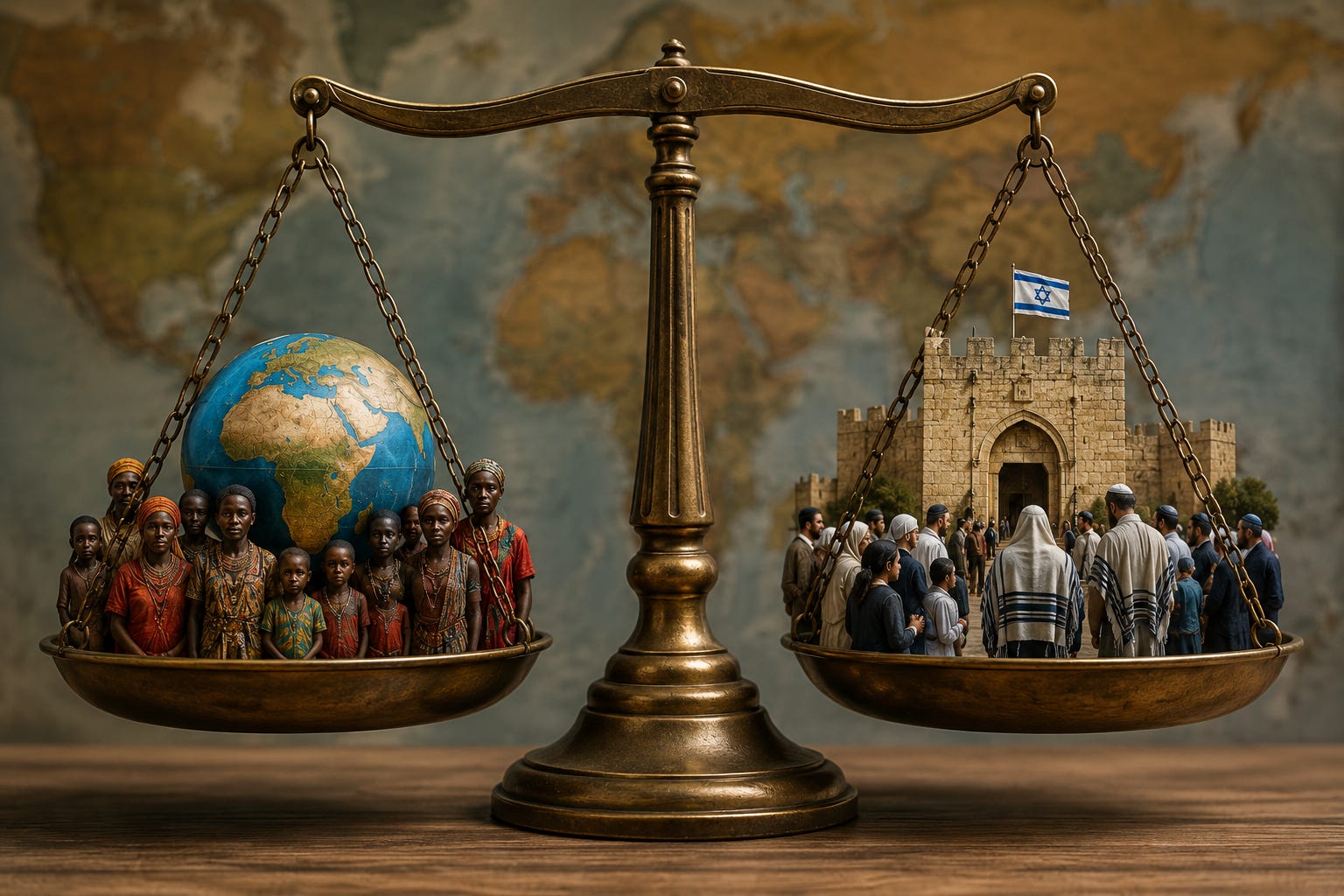
Consider a thought experiment.
Imagine a world in which widely accepted historical and scientific conclusions are casually dismissed. In such a scenario, one might claim that Black people are not from Africa, that Vikings did not originate in Scandinavia, or that the Japanese have no historical roots in Japan. Similar assertions could be made about the Māori, the Cherokee, or Aboriginal Australians.
Such claims would be rejected immediately, as they contradict extensive evidence from archaeology, linguistics, genetics, and recorded history. For example, the African origins of modern humans are supported by fossil discoveries such as Homo sapiens remains at Omo Kibish and by genetic studies tracing mitochondrial DNA lineages to East Africa.
In most contexts, there is broad agreement that historical claims should be grounded in evidence. However, when discussions turn to the Jewish people and the Land of Israel, this standard is sometimes applied inconsistently.
The historical connection between the Jewish people and the Land of Israel is supported by a wide range of sources. Archaeological findings, ancient texts, and linguistic evidence all point to a longstanding presence in the region. The Dead Sea Scrolls, discovered in Qumran and dated between the 3rd century BCE and 1st century CE, provide insight into early Jewish religious life. The First and Second Temples are described in biblical texts and referenced by historians such as Josephus. The Tel Dan Stele, a 9th-century BCE inscription, mentions the “House of David,” offering extrabiblical evidence of a Davidic dynasty. Jerusalem itself appears in ancient records, including the Amarna letters from the 14th century BCE, and has been continuously inhabited for millennia.
The Kingdoms of Israel and Judah are well documented in both biblical and non-biblical sources, including Assyrian records such as the Kurkh Monolith of Shalmaneser III and Babylonian chronicles describing the conquest of Jerusalem in 586 BCE. Roman historians like Tacitus also refer to the Jewish people and their homeland. Archaeological discoveries, including the City of David excavations and the Siloam Inscription, further corroborate these accounts.
Hebrew, a Northwest Semitic language, is attested in early inscriptions such as the Gezer Calendar from the 10th century BCE. It developed over time from Biblical Hebrew to Mishnaic Hebrew and was later revived as a modern spoken language. Jewish religious practices and cultural traditions have long been centered on the Land of Israel. Liturgical texts preserved in the Mishnah and Talmud include prayers oriented toward Jerusalem. Major festivals such as Passover, Shavuot, and Sukkot are tied to the agricultural cycles of the region, as described in the Torah and later rabbinic literature.
These elements—language, religious practice, historical records, and archaeological evidence—collectively demonstrate a sustained and well-documented connection between the Jewish people and the Land of Israel.
Why It Matters in the Present
It is important to distinguish between historical analysis and contemporary political debate. One may hold a range of views regarding the policies or actions of the modern State of Israel. Democratic societies encourage such discussion. However, questioning or denying the historical connection of the Jewish people to their ancestral homeland involves a different kind of claim—one that runs counter to a substantial body of evidence.
When that denial is framed through the language of “colonialism,” it introduces a deeper problem. Colonialism, in its historical sense, refers to a foreign power establishing control over a land to which it has no indigenous roots. Applying that label to the Jewish return to Israel requires ignoring or erasing the very evidence outlined above. It reframes an indigenous people’s documented connection to their homeland as if it were an external imposition.
This is not simply a disagreement over terminology. When a people’s history is dismissed or rewritten in this way, it often reflects more than a neutral analytical error. It can become a vehicle for delegitimizing that people’s identity and presence altogether. In that sense, arguments that deny Jewish historical ties to Israel risk functioning less as historical critique and more as expressions of hostility toward Jews as a people.
Why Visiting the Ancient Sites Matters
One of the most powerful ways to understand this history is not through argument, but through experience.
Standing in the City of David, walking along the ancient walls of Jerusalem, or seeing the Siloam Inscription in person brings the historical record into tangible reality. These are not abstract claims or distant theories—they are physical remnants of a civilization that lived, built, worshipped, and wrote in this land thousands of years ago.
Visiting sites such as the Western Wall, the remains of the Second Temple complex, or the archaeological layers beneath Jerusalem allows one to encounter history directly. The continuity between ancient texts and physical evidence becomes visible. The connection between language, ritual, and place becomes concrete.
For many, this experience clarifies what can otherwise be obscured in political discourse: that the Jewish relationship to the Land of Israel is not a modern invention, but a deeply rooted historical reality.
Consistency and Understanding
Consistency in evaluating historical claims is essential. If evidence-based reasoning is applied in one context, it should be applied in others as well. Recognizing the historical roots of different peoples in their respective regions is a foundational principle of historical scholarship.
Applying this principle uniformly allows for more informed and constructive discussions, particularly on topics that are both historically complex and politically sensitive. It also encourages engagement with the evidence itself—whether through study, dialogue, or firsthand experience—rather than reliance on assumptions or selective interpretations.
In the end, understanding history is not only about what we read, but also about what we are willing to see.
I suspect the people who should learn from this don't have to intellectual capacity to learn. Many of today's high school and university graduates are DEI morons. I would apologize, but anyone who would be offended probably can't read anyway. Another good post, Yonah.
You always speak with such clarity, common sense and logic. If only everyone followed your example!