

There is something I wish every Jew, every friend of Israel, and every person who has ever wondered why this tiny country matters could experience just once.
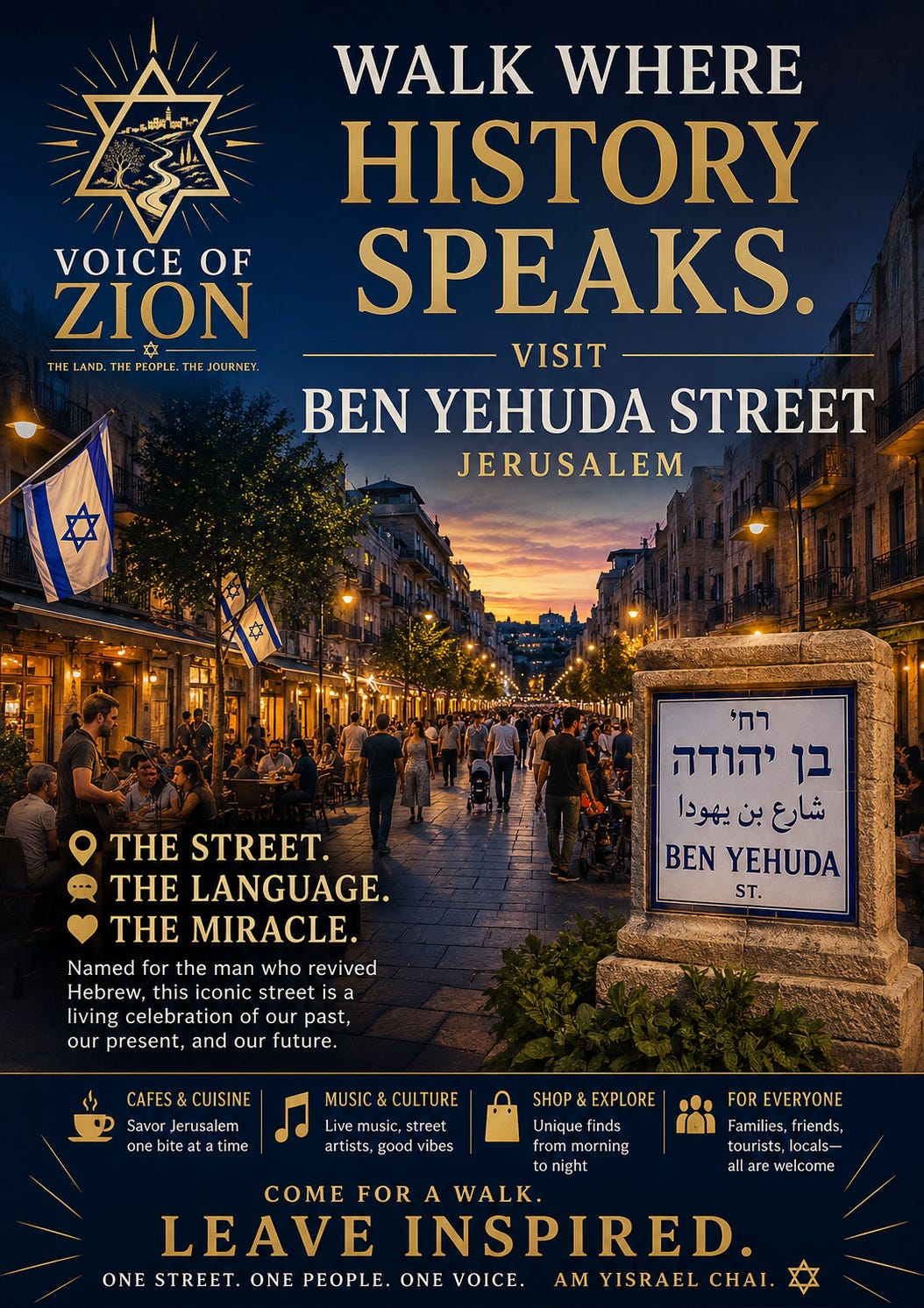
Stand in the middle of Ben Yehuda Street in Jerusalem.
Don’t take a picture.
Don’t buy a souvenir.
Don’t rush to your next destination.
Just stand still… and listen.
What you are hearing is not traffic. It is not background noise. It is not the chatter of another crowded city.
You are listening to the greatest act of Jewish defiance in two thousand years.
Every laugh.
Every argument.
Every child calling for Ima.
Every teenager rolling their eyes.
Every soldier ordering coffee.
Every grandmother telling a family story.
Hebrew.
A language the world assumed would never live again.
This is the part of the Jewish story that no empire ever saw coming.
Babylon thought it could bury us.
Rome believed it had scattered us forever.
The Inquisition tried to erase us.
The pogroms tried to terrorize us.
The Holocaust tried to finish us.
Generation after generation, someone announced that this would finally be the end of the Jewish people.
Instead…
We came home.
And today I walked down a street where the impossible became so ordinary that hardly anyone notices anymore.
Ben Yehuda Street is not simply one of Jerusalem’s most beautiful promenades.
It is the sound of Jewish civilization breathing again.
The cafés spill onto the sidewalks. The smell of fresh coffee mingles with warm rugelach. Street musicians fill the Jerusalem air while children weave between families, tourists, students, soldiers, and old Jerusalemites who have seen history with their own eyes.
It feels effortless.
It wasn’t.
This street bears the name of one of the most stubborn men our people have ever produced.
Eliezer Ben-Yehuda looked at a nation scattered across continents and asked a question almost everyone thought was absurd.
“How can a people truly return home if they cannot speak to one another?”
At the time, Jews spoke Russian, Arabic, Yiddish, Ladino, Persian, English, French, and countless other languages.
Hebrew belonged to prayer.
To Torah.
To memory.
Ben-Yehuda refused to accept that.
He raised his own son speaking only Hebrew, the first native Hebrew speaker in nearly two thousand years. People mocked him. Religious leaders condemned him. Scholars dismissed him. Friends thought he was chasing a fantasy.
He kept going.
He invented words.
He wrote dictionaries.
He built a future one conversation at a time.
He understood something that every Zionist eventually discovers.
A nation is not held together by borders.
A nation is held together by memory.
By language.
By shared dreams.
And then something happened that no historian could have confidently predicted.
The language of Isaiah returned to the mouths of children.
The words of King David became playground conversations.
The language of the prophets became the language of startups, hospitals, classrooms, cafés, weddings, and family dinners.
Today, I walked through that miracle.
Not in a museum.
Not behind glass.
Not as an archaeological exhibit.
I walked through it while a little boy tugged on his mother’s sleeve asking for ice cream.
While two teenagers debated football.
While soldiers laughed over lunch.
While musicians played beneath Jerusalem’s golden stone.
This wasn’t history being remembered.
This was history refusing to end.
Ben Yehuda Street has known blood as well as joy.
Terrorists once believed they could silence these streets with bombs.
They murdered innocent people.
They shattered families.
They tried to replace music with fear.
Look around today.
The cafés are full.
The musicians are back.
Children still chase pigeons.
Life still wins.
That is Jerusalem.
That is Israel.
That is the Jewish people.
We do not deny tragedy.
We outlive it.
As I stood there this afternoon, I realized something that caught me completely off guard.
The greatest monument to Eliezer Ben-Yehuda isn’t the street sign carrying his name.
It isn’t a statue.
It isn’t a plaque.
His monument is the sound.
The thousands upon thousands of ordinary conversations floating through the Jerusalem air.
The language that survived exile.
The language that survived inquisitions.
The language that survived gas chambers.
The language that came home.
I left Ben Yehuda Street today with an overwhelming sense that I wasn’t simply walking through downtown Jerusalem.
I was walking through a Jewish victory so complete that it has become ordinary.
And perhaps that is the greatest victory of all.
Because somewhere, beyond the cafés, beyond the music, beyond the laughter, I could almost hear history whispering its final verdict.
They burned our cities.
They destroyed our Temple.
They scattered us across the earth.
They hunted us in nearly every generation.
And yet here we are.
Back in Jerusalem.
Speaking Hebrew.
Naming our children after our ancestors.
Building.
Creating.
Laughing.
Living.
Not because history was kind to us.
But because the Jewish people never surrendered.
Stand on Ben Yehuda Street long enough, and you’ll discover that it is far more than a destination.
It is a declaration.
Am Yisrael Chai is not just something we sing.
It is something you can hear.
I love your prose poems. Thank you
How I wish Yonah that you started writing about the Israel you love before I came to Israel. I visited Jerusalem twice with tour guides, but never was this street mentioned, and I might have walked on it without knowing. You need to put your wonderful writing into a book, so people can experience the real Israel. I realize that I missed so much, but at least your words put me back in Israel to get a better perspective.