


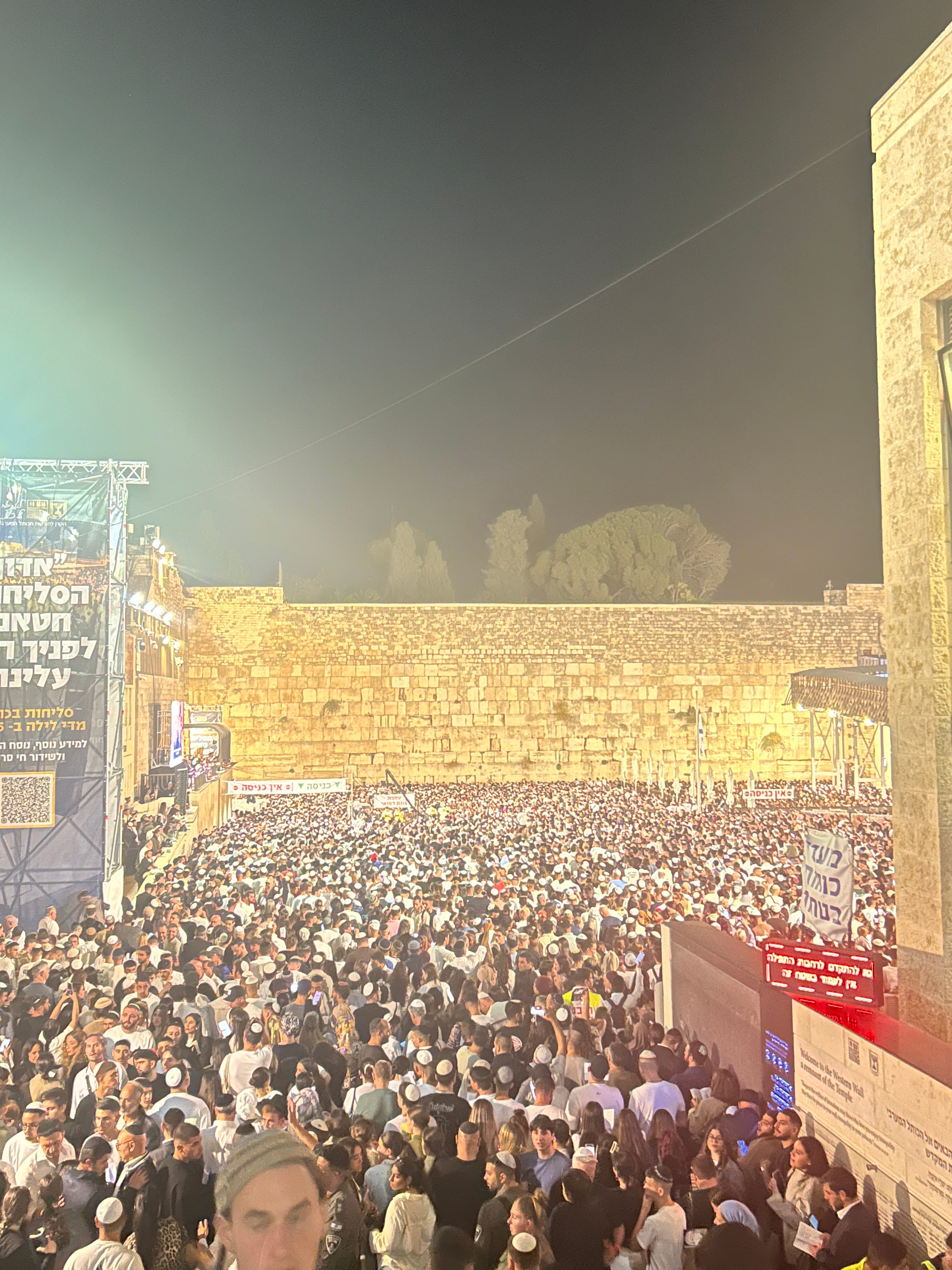
Last night I stood at the Western Wall in Jerusalem with approximately 150,000 Jews.
One hundred and fifty thousand.
Let that number sink in.
Not 150,000 people at a concert.
Not 150,000 fans at a sporting event.
Not 150,000 people gathered because a celebrity showed up or because somebody was handing out free food, although getting that many Jews together with free food would admittedly be considerably easier.
We came to pray.
We came for Selichot.
We came in the final hours before Yom Kippur to stand before the God of Israel and utter the words human beings spend most of their lives trying desperately to avoid:
We were wrong.
We failed.
Forgive us.
And standing there last night, shoulder to shoulder with Jews from every corner of the earth, something inside me cracked open.
Because this wasn’t merely a prayer service.
This wasn’t merely another religious gathering.
This was Jewish history screaming that we are still here.
This was Israel.
All of it.
Standing in one place.
What is Selichot?
Selichot literally means forgiveness.
They are ancient Jewish prayers recited in preparation for Rosh Hashanah and Yom Kippur. Sephardic Jews traditionally begin saying them throughout the month of Elul. Ashkenazi Jews begin closer to Rosh Hashanah.
But that clinical explanation tells you almost nothing.
Selichot is not about reading words from a prayer book.
It is about stripping away the bullshit.
The excuses.
The ego.
The little stories we tell ourselves about why we were right and everybody else was wrong.
For a few moments, Judaism forces you to look into the mirror.
Who did you hurt?
Who did you ignore?
Where did you fail?
Where could you have been kinder?
Braver?
More patient?
More honest?
More Jewish?
Then we repeat the ancient words describing God as compassionate, gracious, patient and abundant in mercy.
We beg.
We confess.
We return.
That is what teshuvah really means.
Not guilt.
Return.
Coming home.
And last night, 150,000 Jews came home together.
And what Jews they were.
Black Jews.
White Jews.
Brown Jews.
Ethiopian Jews.
Persian Jews.
Indian Jews.
Syrian Jews.
Iraqi Jews.
Yemenite Jews.
Moroccan Jews.
Tunisian Jews.
Libyan Jews.
Russian Jews.
Ukrainian Jews.
French Jews.
British Jews.
American Jews.
South African Jews.
Israeli Jews whose families have lived in this land for generations.
Jews whose grandparents spoke Arabic.
Jews whose grandparents spoke Yiddish.
Jews whose grandparents spoke Ladino.
Persian.
Russian.
French.
English.
Amharic.
Men in enormous black hats.
Men in knitted kippot.
Men with no kippah until somebody handed them one.
Chassidim.
Charedim.
Religious Zionists.
Traditional Jews.
Secular Jews.
Soldiers.
Yeshiva students.
Grandfathers.
Teenagers.
Women with wigs.
Women with scarves.
Women in jeans.
People who pray three times a day.
People who probably hadn’t opened a siddur since last Yom Kippur.
And there we were.
Together.
That is Israel.
Not the Israel described in newspaper columns written by people sitting thousands of kilometers away.
Not the Israel reduced to elections, coalition mathematics, military operations and diplomatic communiqués.
The real Israel.
Messy.
Loud.
Argumentative.
Beautiful.
Ancient.
Modern.
Impossible.
And alive.
So unbelievably alive.
Israel even has two Chief Rabbis.
Last night both of Israel’s Chief Rabbis were there.
Israel has an Ashkenazi Chief Rabbi and a Sephardic Chief Rabbi.
Why?
Because Judaism was never one beige, standardized product.
For two thousand years Jews lived across continents, and communities developed different customs, melodies, legal traditions and prayer rites.
A Jew in Baghdad did not sound like a Jew in Warsaw.
A Jew in Fez did not eat like a Jew in Vilna.
A Jew in Aleppo prayed differently from a Jew in Amsterdam.
But they faced the same Jerusalem.
They read the same Torah.
They remembered the same Exodus.
They mourned the same destroyed Temple.
They whispered the same impossible dream:
Next year in Jerusalem.
Then history did something utterly insane.
Their grandchildren came back.
And now the Jewish state has a Sephardic Chief Rabbi and an Ashkenazi Chief Rabbi because both streams of Jewish civilization came home.
Last night they stood at the same Wall.
And with them stood the Prime Minister of the State of Israel.
Think about that sentence.
The Prime Minister of the Jewish state praying at the Western Wall before Yom Kippur.
There were centuries when Jews did not have a prime minister.
We didn’t have an army.
We didn’t have an air force.
We didn’t have passports issued by a Jewish state.
We didn’t have Jewish policemen protecting Jews praying in Jerusalem.
We had prayers.
That was what we had.
Prayers and memory.
And somehow those were enough to keep a civilization alive.
Then there is the Wall.
The Kotel.
The Western Wall.
You can call it archaeological stone if you want.
Fine.
But Jews don’t see stone.
We see memory.
We see longing.
We see generations.
We see grandparents who never made it here.
We see Jews murdered in Europe who whispered Jerusalem before they died.
We see Jews expelled from Spain carrying Jerusalem with them.
We see Jews leaving Iraq with almost nothing except the knowledge of who they were.
We see Ethiopian Jews walking across deserts toward a Jerusalem many had never seen.
We see Persian Jews.
Yemenite Jews.
Russian Jews.
Moroccan Jews.
Syrian Jews.
All preserving the same completely irrational stubborn conviction:
We belong to Jerusalem.
For centuries Jews stood thousands of kilometers away and prayed toward this city.
Imagine that.
A Jew in Poland faced Jerusalem.
A Jew in Baghdad faced Jerusalem.
A Jew in Morocco faced Jerusalem.
A Jew in Yemen faced Jerusalem.
A Jew in Persia faced Jerusalem.
The languages changed.
The clothes changed.
The food changed.
Empires rose.
Empires collapsed.
Borders moved.
Kings disappeared.
Governments vanished.
And the Jew kept turning toward Jerusalem.
Then came 1967.
And Jews returned to the Western Wall.
Suddenly Jerusalem was not merely something whispered at weddings.
Not merely something sung about.
Not merely something carved into Jewish memory.
You could touch it.
Walk to it.
Cry against it.
Bring your children to it.
And last night 150,000 Jews did exactly that.
That fact should never become normal.
Never.
Because Jewish history is filled with people who would have given everything for one night like last night.
Imagine telling our ancestors.
Tell the Jew being expelled from Spain in 1492:
“One day your descendants will stand openly in Jerusalem with 150,000 other Jews.”
Tell the Jew hiding from a pogrom in Eastern Europe.
Tell the Jewish family fleeing Baghdad.
Tell the Jewish mother walking through Sudan on the road from Ethiopia.
Tell a Jew behind the gates of Auschwitz.
Tell them:
“One day there will be a Jewish state.”
“There will be a Jewish army.”
“Jewish pilots will fly Jewish aircraft over Jerusalem.”
“Jewish soldiers will protect Jewish children.”
“And before Yom Kippur, 150,000 Jews will gather freely at the Western Wall and pray.”
Would they believe you?
They might think you had lost your mind.
And yet I stood there last night.
Living inside their impossible dream.
That realization hits you like a hammer.
Because we complain constantly.
Israelis may have turned complaining into a branch of advanced mathematics.
The traffic.
The government.
The bureaucracy.
The cost of living.
The school system.
The parking.
Dear God, the parking.
But sometimes Israel grabs you by the shoulders and reminds you what this place actually is.
It is the answer to thousands of years of Jewish longing.
Not a perfect answer.
Not an easy answer.
But a living one.
And last night nobody cared what kind of Jew you were.
That may have been the most beautiful thing of all.
Nobody asked whether you were Ashkenazi or Sephardi.
Nobody asked which party you voted for.
Nobody asked whether you supported this politician or hated that politician.
Nobody asked whether your kippah was black, knitted or temporarily borrowed from somebody standing nearby.
Nobody asked whether you kept Shabbat perfectly.
Nobody checked your ideological credentials.
Nobody asked whether you were sufficiently religious.
There were just Jews.
Jews praying.
Jews crying.
Jews singing.
Jews asking God for another year.
And there is something almost violent about the beauty of that image.
Because we spend so much time arguing about what divides us.
Then suddenly you stand among 150,000 Jews before the stones of Jerusalem and realize how small so many of those arguments are.
Not meaningless.
But small.
Because beneath all the arguments there remains something deeper.
A memory.
A covenant.
A people.
This is modern Israel.
Modern Israel is not one ethnicity.
Not one color.
Not one accent.
Not one political ideology.
Not one religious community.
Israel is an Ethiopian grandmother walking next to a Russian teenager.
It is a Persian family sharing space with French immigrants.
It is an Iraqi melody coming out of one corner while a Chassidic niggun rises from another.
It is a secular soldier standing next to a yeshiva student.
It is a woman whose grandparents fled Morocco walking through the same Jerusalem as a man whose grandparents escaped Poland.
It is Hebrew spoken with Russian accents, French accents, American accents, Ethiopian accents and the unmistakable Israeli accent that sounds like somebody is arguing with you even when they’re merely asking where the bathroom is.
This is what Jewish return looks like.
It is not neat.
History isn’t neat.
It is noisy and inconvenient and emotional and occasionally completely insane.
But it exists.
That is the miracle.
Last night the Kotel was not divided into history.
Past and present became the same thing.
You heard the ancient words.
You looked at the stones.
You looked at the crowd.
And suddenly King David didn’t feel ancient.
The destruction of Jerusalem didn’t feel like a paragraph in a textbook.
Exile didn’t feel abstract.
The Holocaust didn’t feel disconnected.
1948 didn’t feel like black-and-white photographs.
1967 didn’t feel like something that happened before many of us were born.
It all felt connected.
One long Jewish story.
A story filled with grief beyond comprehension.
But also survival beyond explanation.
The Romans are gone.
The Crusaders are gone.
The Ottoman Empire is gone.
The British Empire left.
Babylon is history.
Assyria is history.
Whole civilizations that ruled over Jews disappeared into museums.
And somehow the Jew is still standing in Jerusalem.
Still arguing.
Still praying.
Still singing.
Still raising children.
Still saying the same words.
There is something almost comical about our refusal to disappear.
History has been trying to get rid of us for thousands of years.
We are apparently very bad at taking hints.
And that is why Selichot at the Kotel is different.
You can pray Selichot anywhere.
A synagogue in New York.
London.
Johannesburg.
Paris.
Melbourne.
Toronto.
You can say every word perfectly.
But Jerusalem does something to those words.
Because here the prayers collide with geography.
You aren’t only saying Jerusalem.
You are standing in Jerusalem.
You aren’t imagining the Wall.
Your hand is touching it.
You aren’t praying toward Zion.
You are standing in Zion.
Thousands of years of Jewish memory suddenly become physical.
Stone.
Dust.
Voices.
Tears.
And 150,000 beating Jewish hearts.
I looked around and thought: this is what victory looks like.
Not victory over another people.
Not military victory.
Something much older.
Victory over disappearance.
Victory over assimilation.
Victory over hopelessness.
Victory over the countless voices throughout history that told the Jew:
Your story is finished.
Your God has abandoned you.
Your Jerusalem is gone.
Your children will forget.
Your people will disappear.
They were wrong.
Last night was the evidence.
One hundred and fifty thousand pieces of evidence.
Standing in Jerusalem.
Praying.
Tonight comes Yom Kippur.
We will stop eating.
We will stop drinking.
We will confess.
We will beat our chests.
We will say words that are uncomfortable because Judaism understands something modern society frequently forgets:
You cannot improve if you are incapable of admitting that you screwed up.
And we will ask God to write us into the Book of Life.
But last night came first.
Selichot.
The knocking at the door.
The return.
And standing at that Wall, surrounded by my people, I kept thinking about all the Jews who dreamed of being where I was standing.
I wished they could see us.
I wished my ancestors could see us.
I wished the Jews of Baghdad and Warsaw and Fez and Tehran and Johannesburg and Aleppo and Vilna could see what became of their children.
I would want them to see the soldiers.
The Hebrew signs.
The Israeli flags.
The Chief Rabbis.
The Prime Minister.
The children sitting on their fathers’ shoulders.
The old women crying.
The young people singing.
The enormous sea of Jews filling Jerusalem.
And I would want to tell them:
You made it.
Maybe not you personally.
But your children did.
Your grandchildren did.
Your people did.
We came home.
And we remembered.
150,000 Jews.
One Wall.
One Jerusalem.
One people.
One God.
Different colors.
Different accents.
Different customs.
Different politics.
Different levels of observance.
But when the ancient prayers rose over Jerusalem last night, none of that seemed bigger than who we were.
Jews.
Still here.
Still praying.
Still returning.
Still building.
Still remembering.
Still alive.
After everything.
We are still here.
And we are standing in Jerusalem.
Am Yisrael Chai.
With a tear of joy and a tear of pain, I live. Jerusalem lives. Israel lives. Jews live in Jersalem, in Israel.
Never forget.
Never be defenseless.
The Lord, Our G-d, has smiled upon his children and blessed them with life.
Am Yisrael Chai.
ALL THE GLORY OF THE G-D OF HEAVENS ARMIES IS WITH YOU NOW‼️🙏 AMEN And HALLELUJAH AMEN❣️🙌❤️😻🇮🇱🇮🇱🇮🇱🌈💕